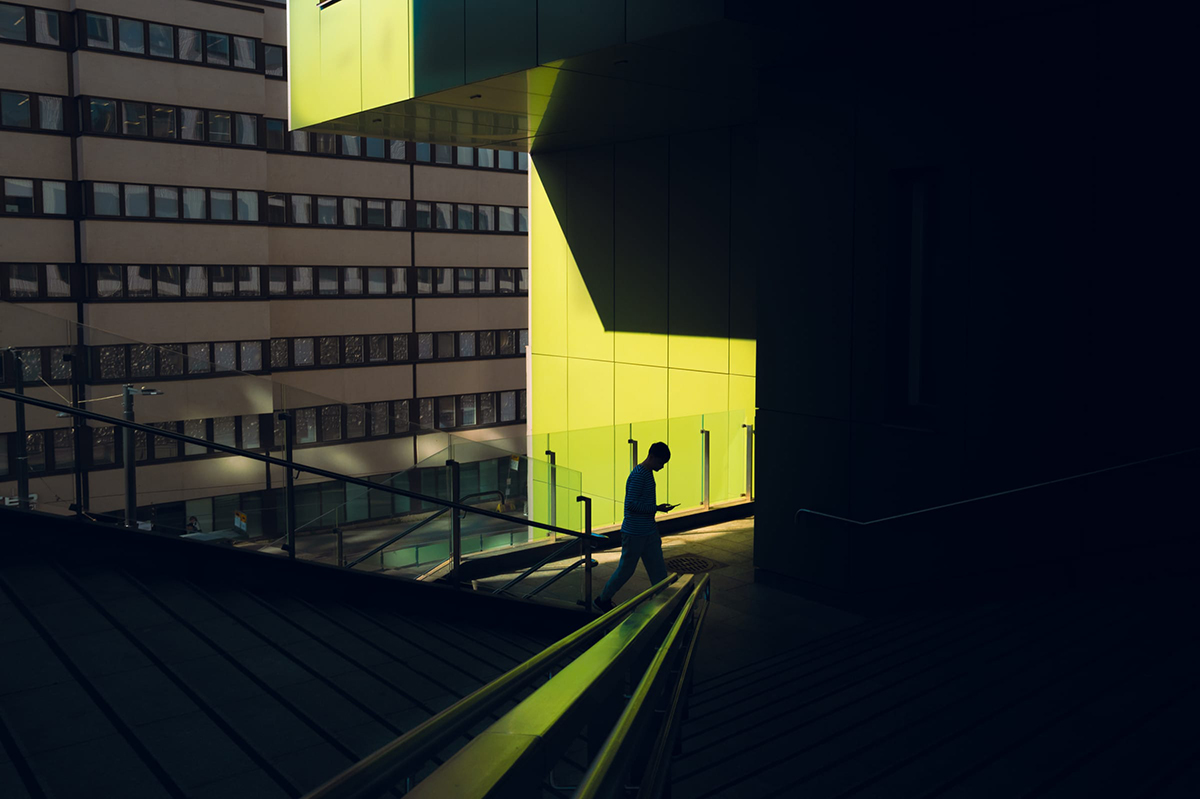
I shot one frame with hard light and clean geometry. A detector called it 99% AI. The machine read craft as prompt.
Yesterday I shot a street photograph with my Leica Q3. Low sun cutting between two buildings, a yellow panel wall lit up like a lightbox, everything around it already gone to shadow. A guy in a striped shirt walked into the last strip of light, looking at his phone. One frame.
No generative fill. No composite. No noise removal. Curves, saturation, a little vibrance, and I straightened it, because I can’t live with a leaning vertical. That’s the entire edit.
Out of curiosity, I ran it through a popular AI image detector.
Red bar. 99% FAKE. Confidence: high.
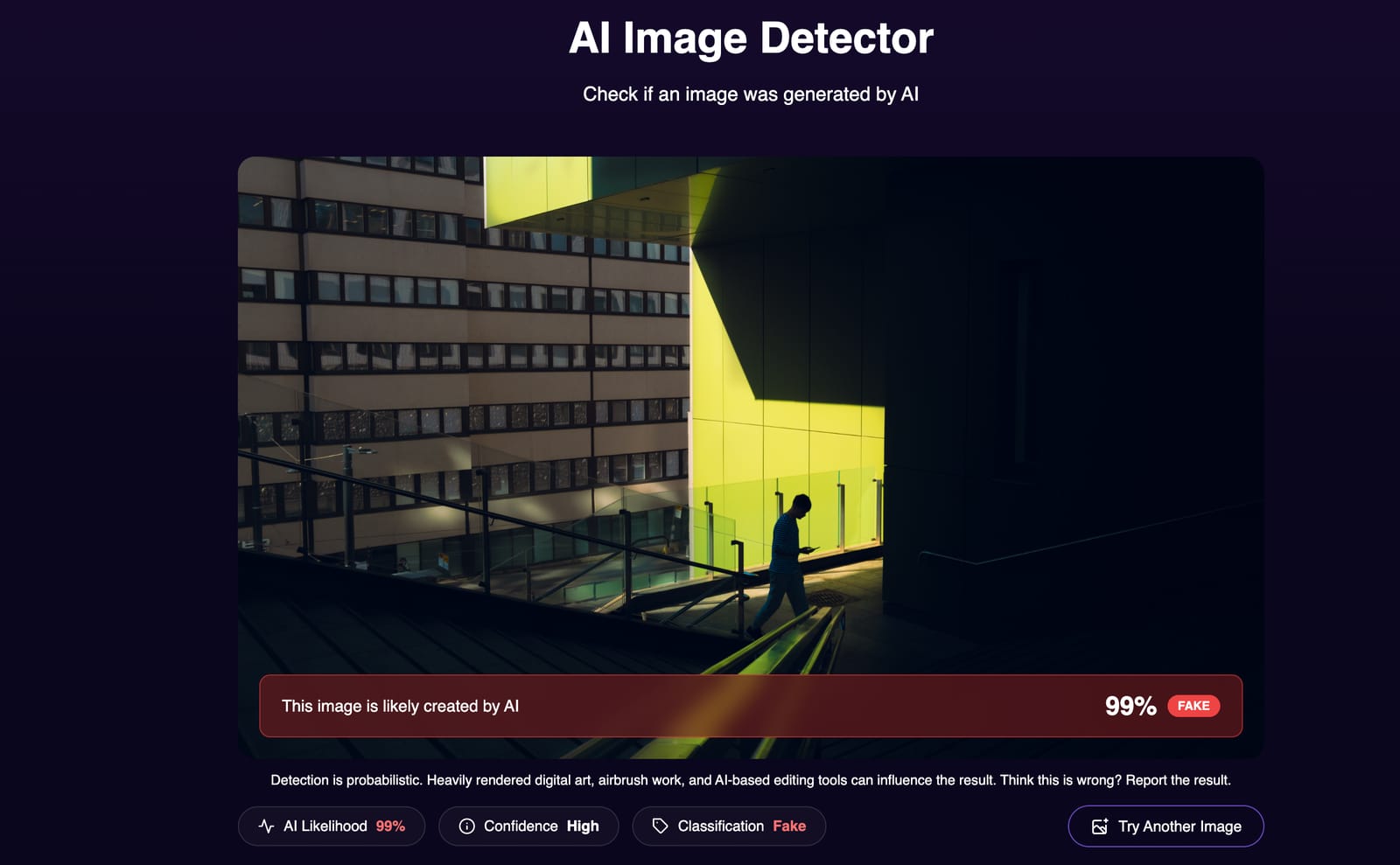
Here’s what the machine actually did, and it isn’t clever.
These detectors don’t understand light. They don’t understand physics, or the fact that a building can genuinely look like that at seven in the evening. They compare statistical patterns. They hunt for the mess a sensor leaves behind: grain, compression artefacts, the microscopic noise that proves a lens was involved. My frame is two enormous flat fields, one black, one yellow, with a silhouette between them. Crush the shadows and the grain goes with them. Push the yellow and it flattens into one continuous block of colour. Straightening resamples every pixel in the file and smooths whatever was left. None of that is cheating. All of it erases the fingerprint the detector is looking for.
So it penalised me for exactly what I was trying to do. Hard light, sharp geometry, deep contrast, nothing in the frame that didn’t need to be there. The machine read craft as prompt.
I could shoot flatter. Leave the grain in, keep the highlights polite, give the algorithm something to chew on. That’s not a style, it’s a compliance strategy, and it would make the pictures worse.
The tool isn’t what worries me. It’s free, it’s one click, and it’s wrong in a way anyone can demonstrate in four minutes.
What worries me is how fast people accept the verdict. A red bar appears and the thinking stops. The label does the judging. Whatever the photographer offers afterwards, the DNG, the EXIF, the frames either side of it on the same card thirty seconds apart, all of it lands underneath something nobody reads. The accusation costs one click. The defence costs a paragraph.
We built these things to help us think, and we’re using them to avoid it.
When did we agree that a blind algorithm outranks a human eye?
This gets worse before anyone fixes it, and it won’t stay in photography. Anything made well enough, written, drawn, designed, composed, is going to trip something. Signed files and content credentials are coming. They’ll help. They won’t arrive in time for the person who already decided.
The machine wasn’t there. I was.