
Trust isn't a feature. It's the receipt of every small decision a system made while the user wasn't watching.
A farmer in northern Finland opens an app, photographs a field note, and waits. The AI processes the observation. Two seconds later it suggests nitrogen deficiency and recommends a treatment.
The farmer pauses.
Not because the suggestion is wrong. But because they didn’t expect that specific answer from that specific observation. And in that pause, something is being decided that has nothing to do with nitrogen.
Trust is formed or broken in moments exactly like that one.
The confidence trap
Most AI products are designed to project confidence. Confidence feels like quality. A result delivered with certainty reads as competence. So products hide the seams, smooth the edges, present conclusions without context.
That works, until it doesn’t.
The first time the system is wrong, and the user has no way to evaluate why, the trust collapses completely. Not partially. Completely. Because the user was given no tools to calibrate their own judgment. They were just supposed to believe.
Projected confidence without transparency isn’t a design choice. It’s a deferred liability.
What trust is actually made of
Trust in a product is never a single feature. It’s the receipt of every small decision the system made while the user wasn’t paying close attention.
Does the system explain why it suggested this? Does it acknowledge what it doesn’t know? Does it stay consistent, or does it surprise you in ways that feel arbitrary? When it’s wrong, does it make that obvious, or does it hide behind a confident interface?
These aren’t UX nice-to-haves. They’re the material trust is built from. And they compound. Every time the system behaves predictably, trust accumulates. Every time it doesn’t, it drains, faster than it was filled.
Show the reasoning, not just the conclusion
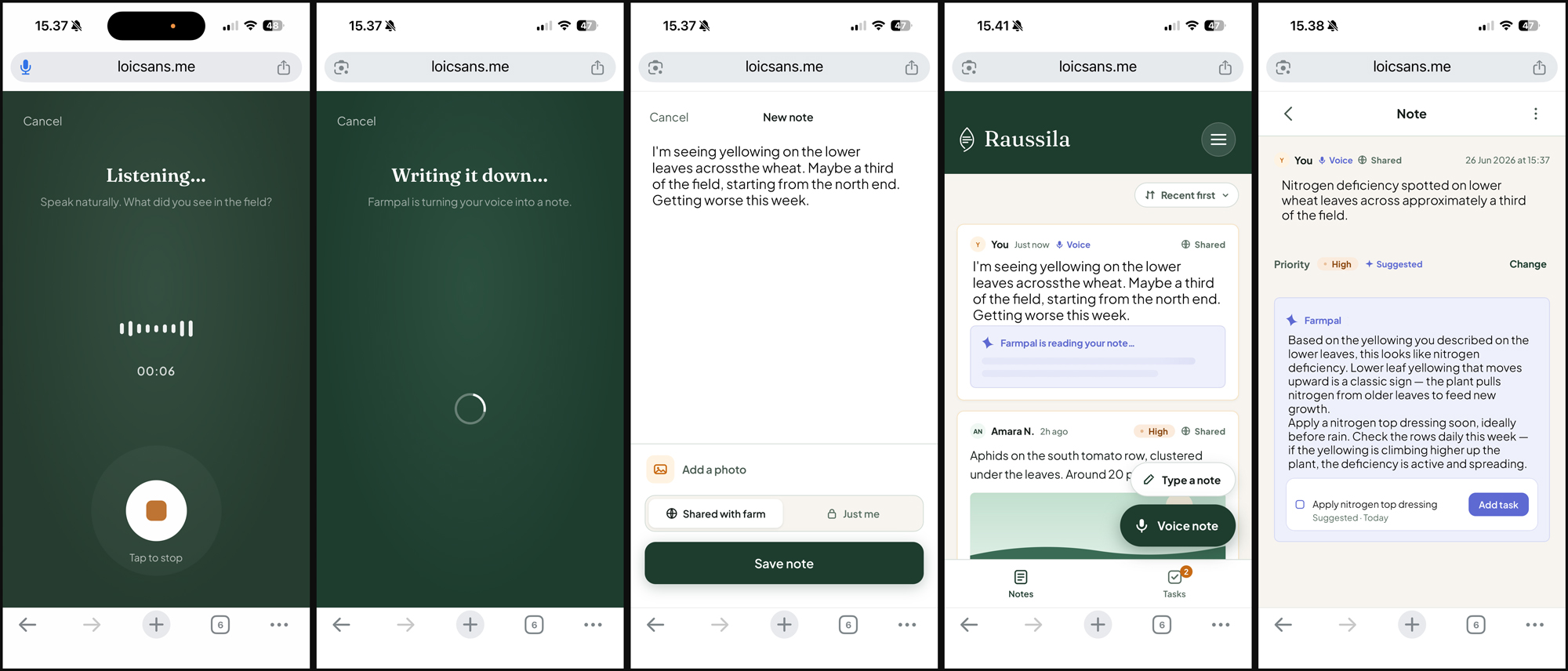
Working on Farmscribe, a mobile note-taker that turns a farmer’s field observation into structured data and contextual advice, clarified something I’d been circling for a while. The design decision that matters most isn’t the suggestion. It’s the reasoning behind it.
“Nitrogen deficiency detected” is a vending machine. It delivers an answer and asks you to accept it.
“Based on the yellowing you described, this looks like nitrogen deficiency” is a colleague. It shows its working. It anchors the conclusion to something the user already knows. It invites verification instead of demanding compliance.
The difference is one sentence. The effect on trust is not small.
When users understand the reasoning, two things happen: they catch the errors faster, and they’re more forgiving when errors occur. Both are good for the product. More importantly, both are good for the user.
“I’m not sure” is a valid system state
There’s a state almost nobody designs for. The state where the AI isn’t certain.
Not wrong. Not broken. Just uncertain.
In most products, uncertainty gets masked behind confidence because uncertainty feels like failure. But to a user, visible uncertainty is trust-building. It says the system knows what it knows and doesn’t pretend otherwise. It says the interface is honest, not just polished.
“I’m not sure” should be the first thing you wire up, not the afterthought you squeeze in at the end.
Trust has a visual language
It operates below the level of words, which is why it gets overlooked.
Systems that carry trust use space deliberately. Density signals efficiency. Space signals care. The choice between them tells the user something about whether the product is in a hurry to close the interaction or willing to give it the time it needs.
They avoid motion that serves no function. Decorative animation doesn’t delight, it distracts. Every transition that communicates nothing registers as noise, and noise is the opposite of trust.
They design for the uncomfortable states. The error state. The uncertain state. The empty state. These are where trust is actually built, not on the happy path where everything works and nobody is tested. The happy path is the easy part. The edge cases are where the product’s character shows.
Back to the field
The farmer in northern Finland. The pause before acting on an AI suggestion.
That pause is the product’s moment of truth. Everything that went into the design either justified the trust or didn’t. The reasoning shown or hidden. The uncertainty acknowledged or masked. The interface honest or just confident.
Good design doesn’t eliminate the pause. It makes the right decision easier to reach inside it.
Working on an AI product and thinking about trust? Let’s talk.