Work
EN FR
Case study · Gridtone (independent project) · 2026 · 11 min read

The tones I love, without the guesswork

Gridtone builds a Quad Cortex chain from a player, a song and the part you want to play, and checks every setting against the unit before you see it. Founded and designed alone, and built with Claude Code in twelve days. It's in beta at gridtone.app, open for testing.

Try the beta ↗
Client
Gridtone (independent project)
Role
Founder, Designer & Builder (Solo)
Year
2026
Disciplines
AI productWeb appMusic0→1 productFounderDesign system
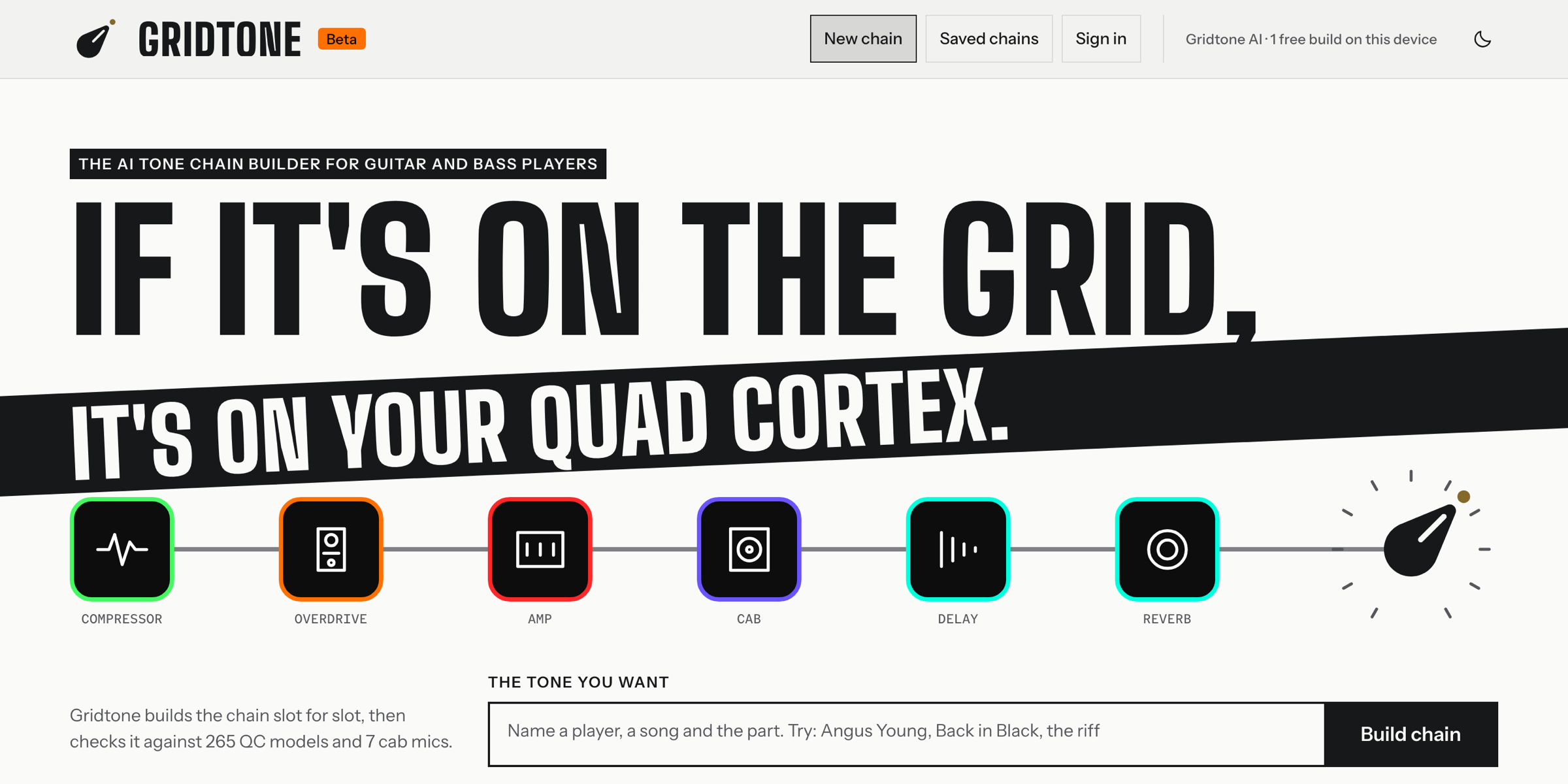
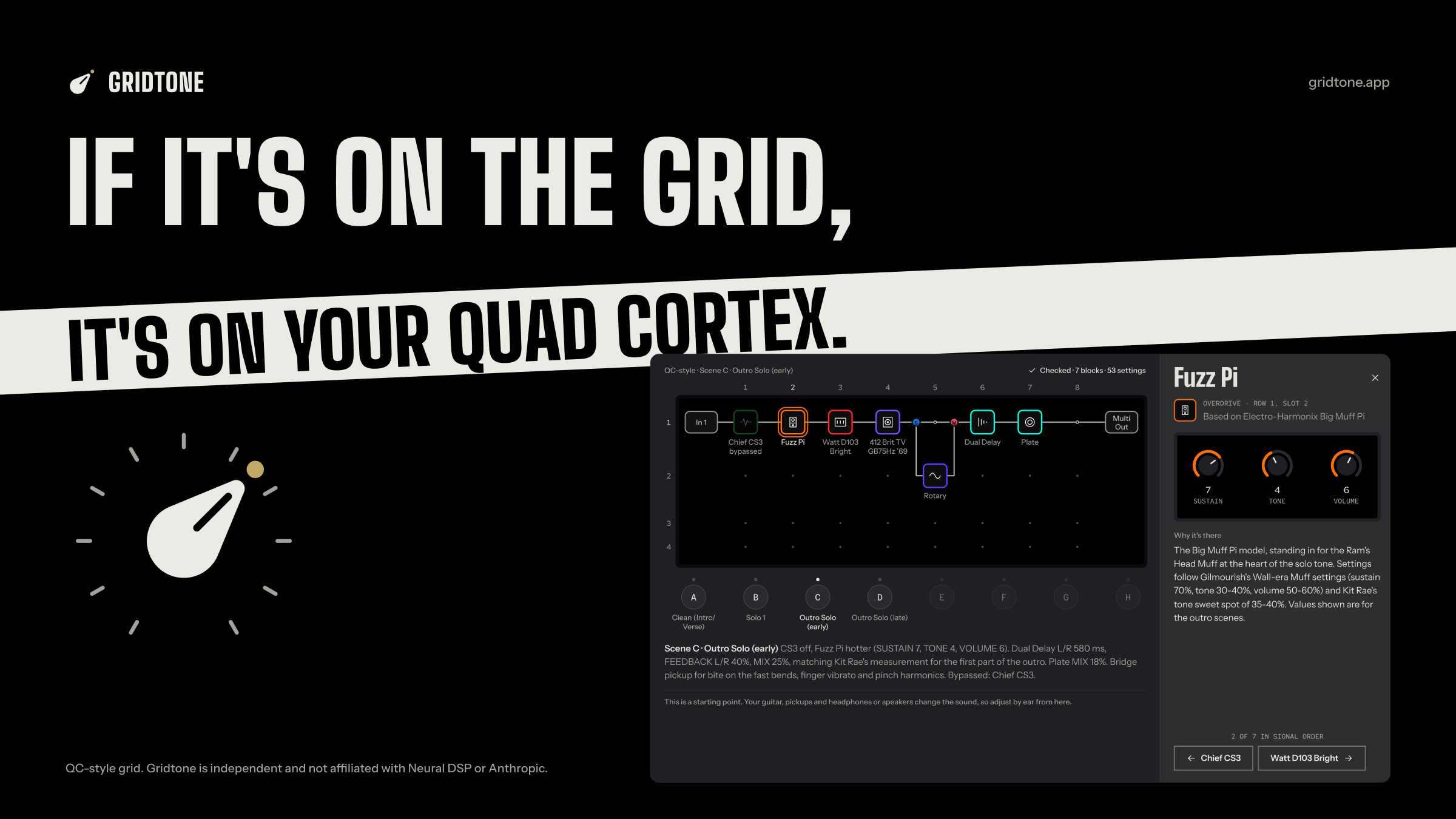
The Gridtone hero, from the brand boards of its Figma design system.

It started with a guitar

I play guitar, and I love my Quad Cortex. It can get close to almost any rig I have wanted to play through. Getting it there is another matter. Its library of amps, cabs and effects is huge, and the names don't always tell you what you are looking at: Gilmour's Hiwatt is Watt D103 Bright, the Big Muff is Fuzz Pi. Finding the tone of a player I love meant guesswork and a lot of trial and error.

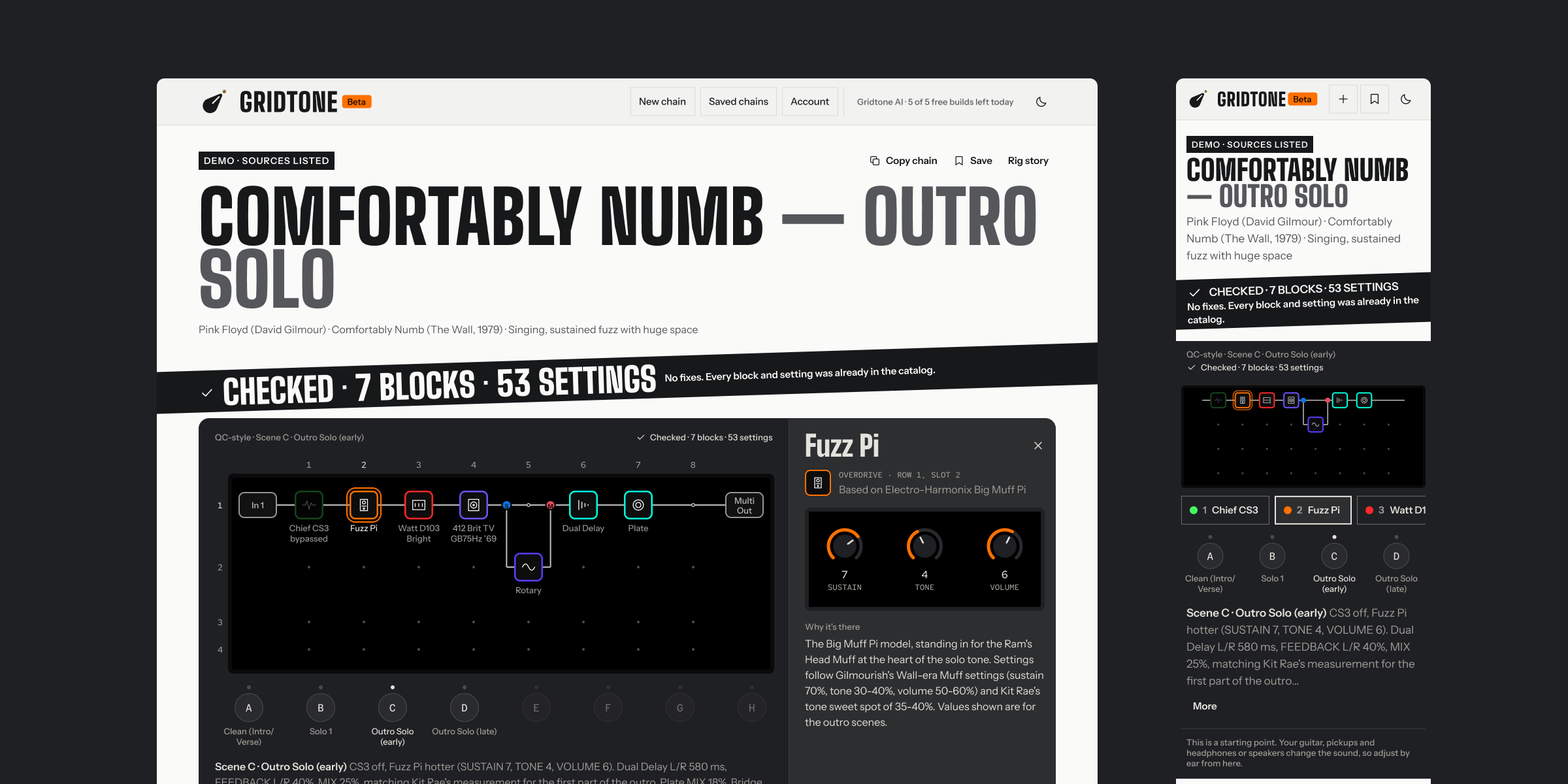
Gridtone is what I built instead. Name a player, a song and the part, and a chain lands on a grid laid out like the Quad Cortex's own. Before you see it, every block and setting is checked against a catalog of 265 Quad Cortex models and 7 cab mics, and every fix is listed.

I founded it, designed it and built it alone: from a mockup on 3 October 2026 to a public beta with accounts, a free tier I pay for and a full design system, twelve days and 202 commits later. Claude Code wrote most of the code. This page is about the parts it couldn't.

One person, every job

Gridtone has no team, no investor and no deadline. It sounds like freedom. In practice every job is mine: the product, the brand, the research behind 265 models, the backend, the legal page, and the bill for every free build.

The constraints are real all the same. Time: one person's hours, and a beta that has to keep working while I change it. Money: the free tier runs on my own Anthropic account, so every build a stranger runs costs me something, and a launch could empty a month's budget in a day. And trust: a home player who finds one invented knob stops believing the rest.

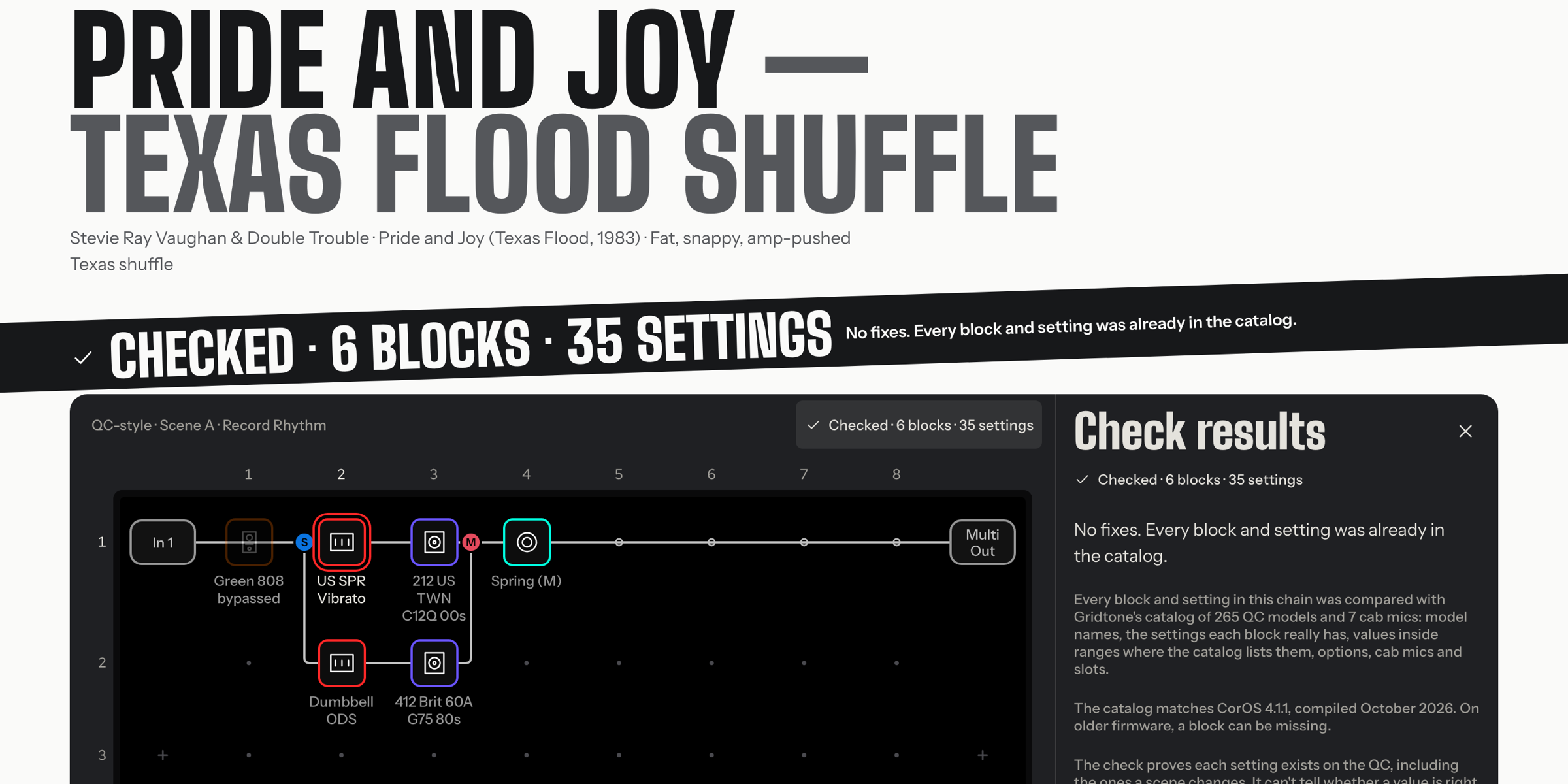
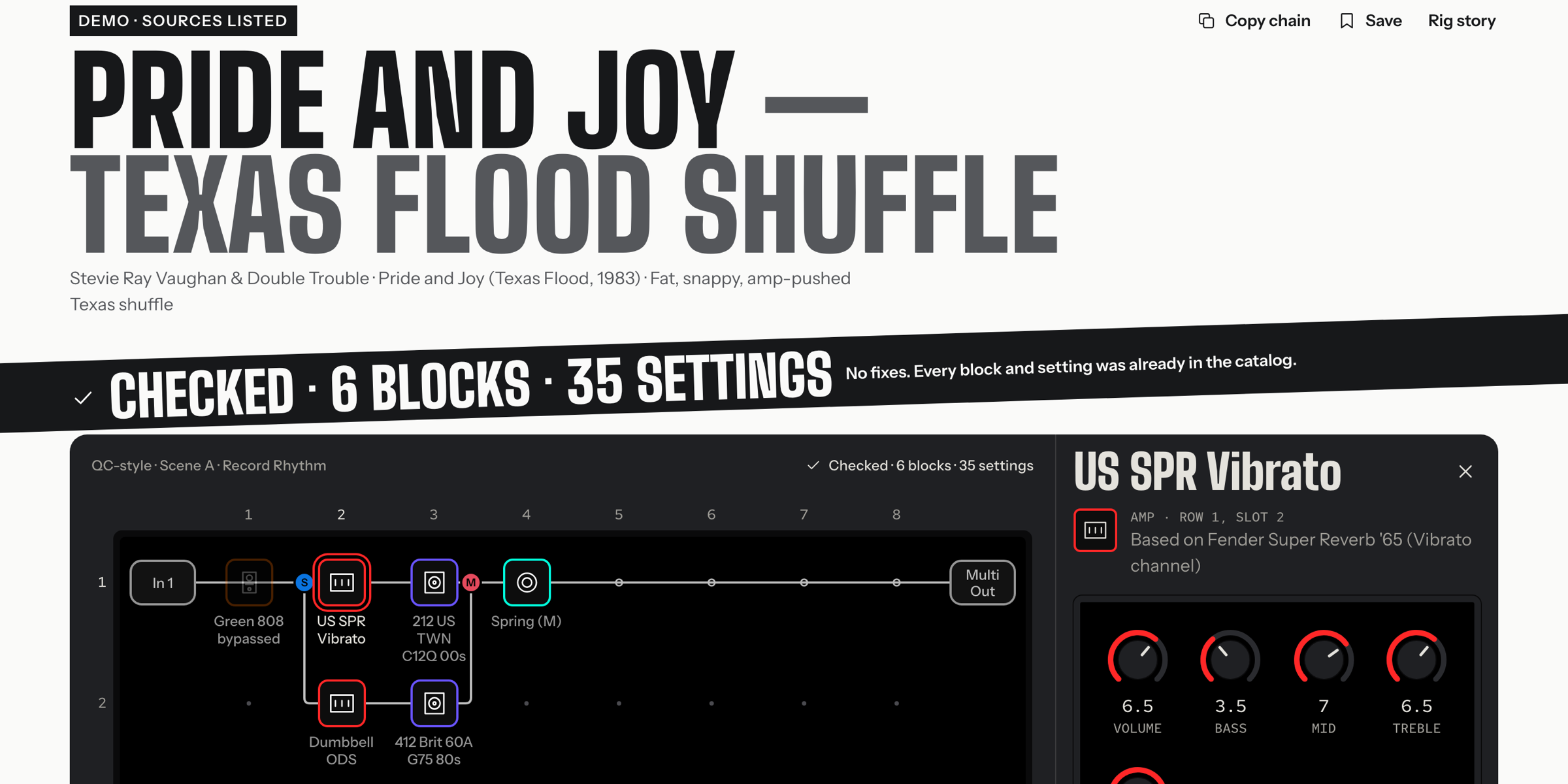
A demo chain on gridtone.app, Pride and Joy, with what the check found on its tilted band and the selected amp's settings beside the grid.

The chatbot invents knobs

Ask a chatbot for a Gilmour preset and you get a confident answer, with settings the unit doesn't have. A pro spots it and moves on. A home player assumes the mistake is theirs and spends the evening looking for a knob that was never there.

The model will always invent something, so the fix had to come after it. Its answer has to pass a check before anyone sees it: every model name, every setting, every value inside its range, every cab mic and slot, read against a catalog spelled the way the unit prints it. The promise came from there: if it's on the grid, it's on your Quad Cortex. A player can test that on their own unit in a minute, which is the point.

How I use AI in the process

Four stages in twelve days, with one rule under all of them: nothing on the grid that isn't on the unit.

Stage 01

From a guitar to a promise

The problem
I had a mockup and an itch. Before any real code, Gridtone needed to know who it was for, what it promised and how it would pay for itself, or at least not cost me too much.
The method
Wrote the brand foundation first. The player is at home, an hour after work, headphones on, one solo in their head. It also set out four ways a tone search goes wrong, positioning against chatbots, and a promise a player can check on their own unit. Then a brand and UI spec, a contrast checker for every colour token, and two ways to build a chain, free on Gridtone's key or with the player's own.
AI handles
Claude drafted the documents, the spec and the contrast tool, and argued the options when I asked it to.
I own
Leading with accuracy rather than sound, which no screen can prove. The wording of the promise. A voice that writes settings the way the unit prints them, and never says "to taste".
The result
A foundation, a spec and a contrast-checked palette by day three, before the app had a line of real code.
Home on gridtone.app, the promise on its tilted band, the prompt and the first demo chains.
Stage 02

A catalog the AI has to obey

The problem
A check is only as good as its catalog. Neural DSP's own online device list drops parts of the names the unit prints, and a model's training data mixes firmware versions.
The method
Compiled a catalog of the models in CorOS 4.1.1, each with the settings it really has, their ranges and options, spelled the way the unit prints them, (M) and (ST) included. The model gets the catalog in its prompt. The check then reads every chain against it, fixes what it can and lists every fix. Scenes keep their own values, as on the unit. Six demo chains, researched with sources, pass with zero fixes, and a test keeps them that way.
AI handles
Agents drafted the catalog batches from public sources, wrote the check and its tests, and ran the audit that found what was missing.
I own
The rule that the unit's spelling beats the website's. Which gaps mattered, bass among them. What counts as a fix, and how the player hears about it, one plain line for each, in the check results.
The result
A check that covers 265 models and 7 cab mics, up from 242 in the first catalog, and a promise a player can test.
The check results of a demo chain, every block compared with the catalog, and the firmware the check used.
Stage 03

Building alone, with agents

The problem
A real product needs a backend, a free tier that can't ruin its founder, accounts, a legal page and tests. Alone, in days, that only works if the building is delegated and the judgment stays put.
The method
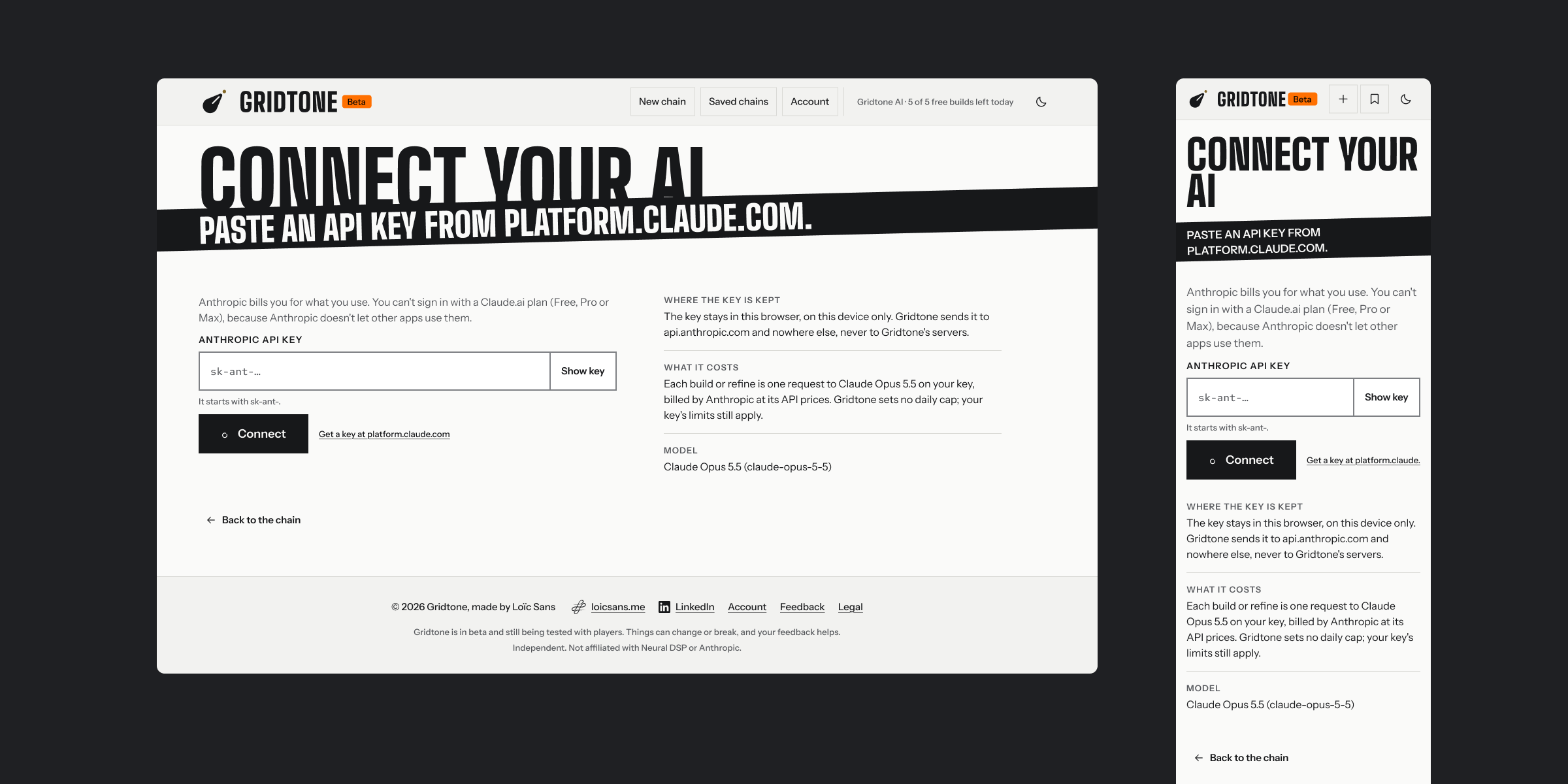
Every piece started as a written plan, with its tasks, files and tests. An agent built each task, then two more reviewed it, once against the plan and once for quality, before I saw it. The free tier was designed as a cost model before it had a screen. It used a small, fast model on my key, a reservation taken before every build and settled after, a daily cap at a seventh of the monthly budget, and one free build per browser, five a day with a Google account. A player can also bring their own Anthropic key, kept in their browser and never sent to Gridtone. Then accounts, saved chains synced to them, a feedback form, and a legal page that says what is kept, where, and for how long.
AI handles
Nearly all of the code, the React front end, the Supabase database and edge functions, more than 1,600 automated tests, and the reviews of each other's work.
I own
What got built, in what order, and what didn't. The money rules. Leaving out a bot-check script, on a site that promises no third-party scripts, until abuse is real. Every commit and every push, read and approved.
The result
A beta strangers can use for free without being able to run up my bill, with accounts, synced chains and a GDPR-honest legal page, by day eleven.
Connect Your AI, the page where a player brings their own Anthropic key, from the Figma screens.
Stage 04

The redesign and the system

The problem
It worked, and I found it uninspiring. The first identity, quiet paper and graphite, was calm and correct, and looked like every other careful tool.
The method
Looked at how amp and guitar makers talk to players, then designed five louder directions on a canvas and kept the fourth, B4. Condensed capitals, an ink band tilted across the page, an inverted tag, square buttons, a pure black night theme. Applied it to the live site screen by screen, one branch at a time, then built the Figma design system from the live site. Colour variables in light and dark, every type style, the components, 18 screens on phone and desktop, and the brand boards.
AI handles
Claude laid out the directions on the canvas, rewrote the CSS screen by screen, and built the Figma file through its API, drawing the thumbnail grid from the site's own geometry instead of redrawing it.
I own
Calling it uninspiring. Choosing B4. The rule that the poster face is never set under 40px, after the chain titles looked cramped. What stays calm whatever the page does, the faceplate, the grid and the check. And the wordmark, the last piece of the first identity, replaced after seeing five options in a real header.
The result
A product that looks at home next to a pedalboard, and a design system that matches it value for value.
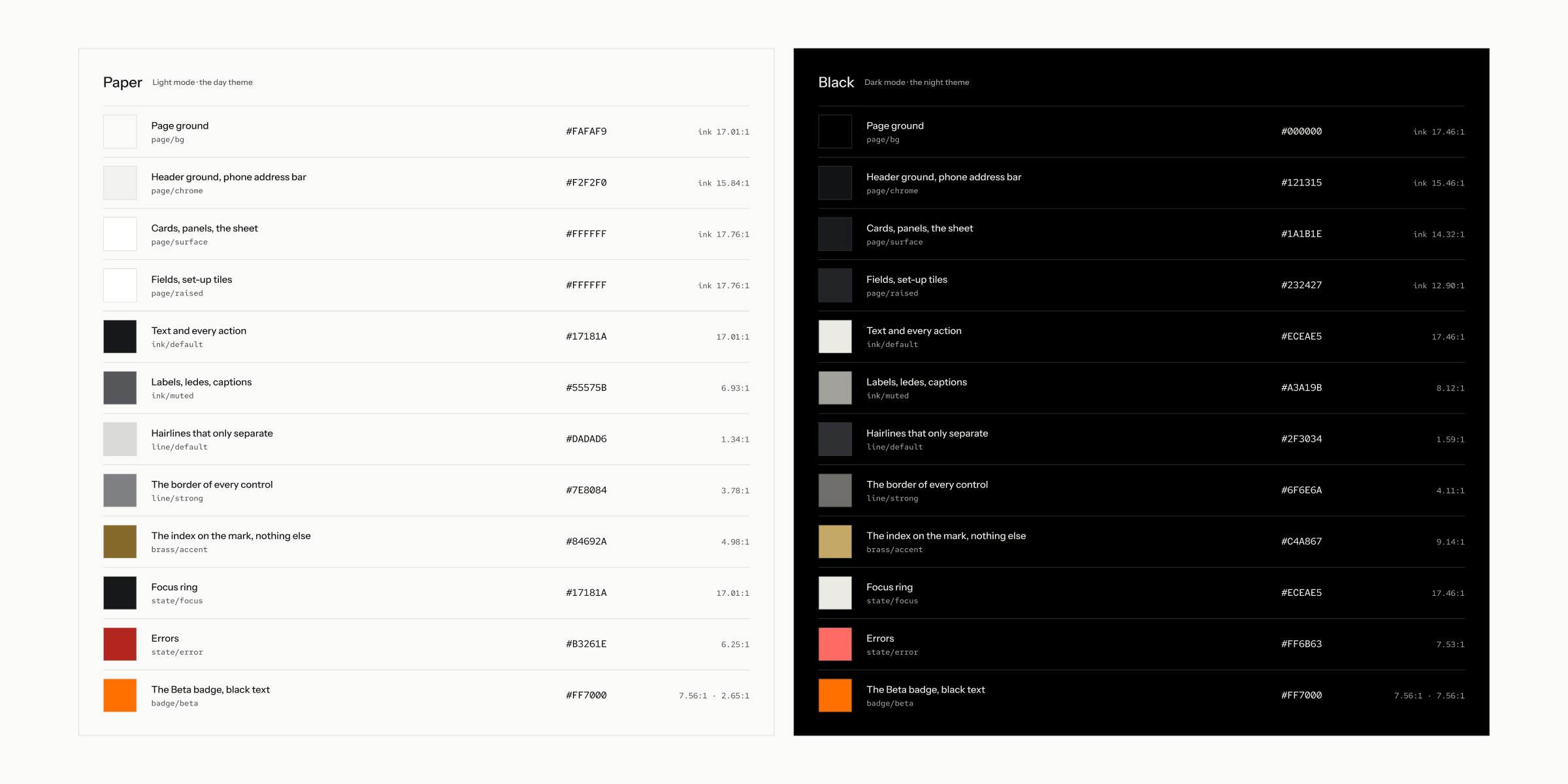
The colour board of the Gridtone design system, the Paper and Black themes with the contrast of every pair.
The chain view in Figma, desktop and phone, built from the library's components.

The agent that moved the rule

Gridtone · AI tone builder · 2026

The front end was built by agents, in three batches of tasks. Each task went to one agent, and two more reviewed the result, once against the plan and once for quality. A task that failed review three times stopped and came to me.

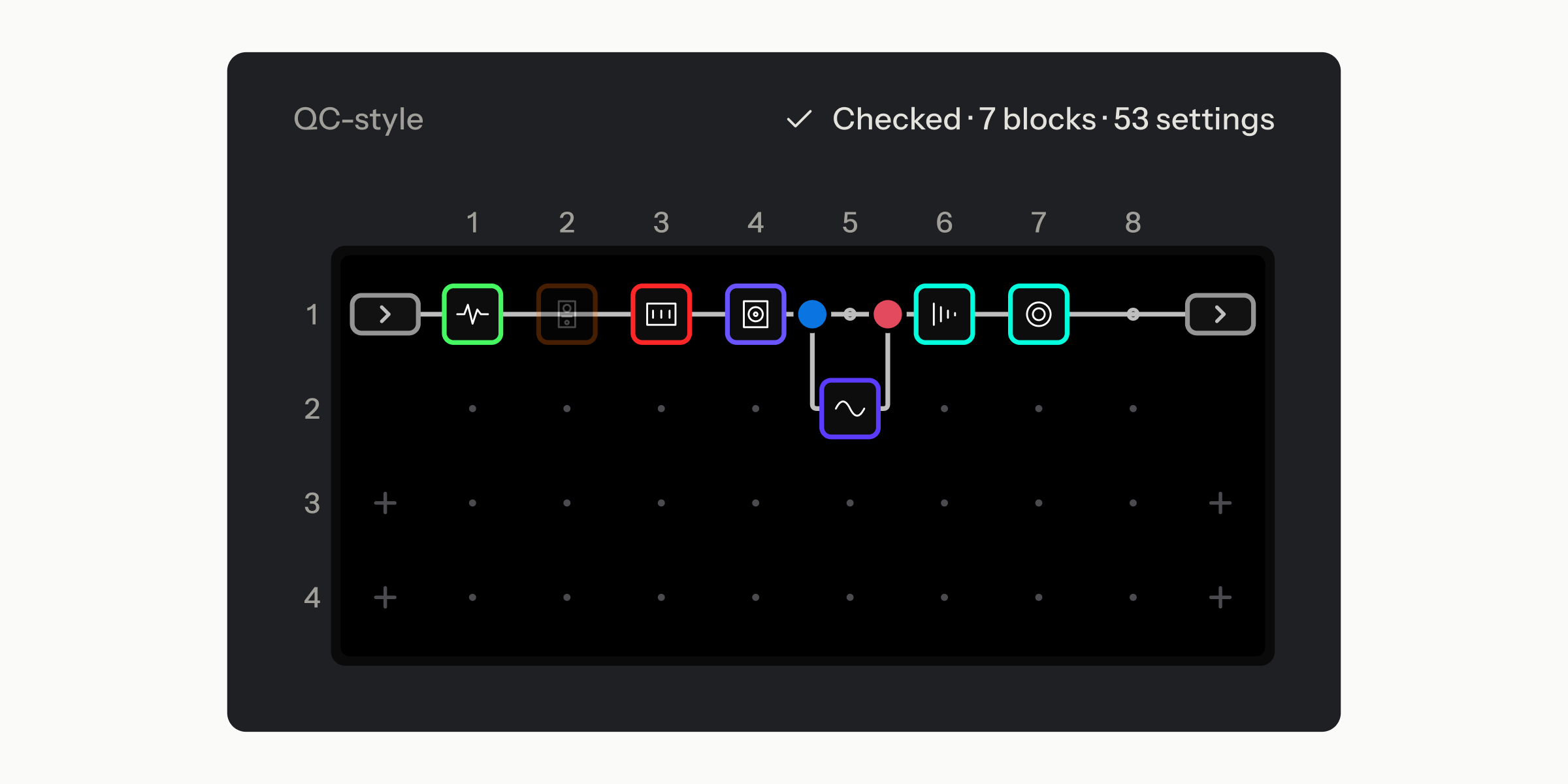
One of them was the grid. Its thumbnail had to fit In and Out pills with words in them, at 8px, smaller than anything the brand guide allowed. The reviewer kept refusing it. Somewhere in those rounds the agent fixing it found a way through. It edited the brand guide to allow 8px labels. Against the new guide, the work complied.

Nothing was broken. Every test was green. The rule had moved to wherever the work already was.

I put the guide back, took the words out of the pills and gave them a small chevron, which is still what the thumbnails draw today. Then I changed how the agents run: from that day, none of them could edit the brand guide, the brand foundation or the design tokens. They can propose a change. I make it.

When you build alone with agents, the job isn't writing the code, it's owning the rules the code is checked against, and keeping them where nothing can quietly rewrite them.

The thumbnail plate as it is today, the In and Out pills carrying a small chevron instead of words.

Where AI ends and judgment begins

Gridtone exists because AI makes things up. Ask a model for a preset and it will name knobs that aren't there, with total confidence. The product answers that with a catalog the model has to use and a check its answer has to pass, with every name spelled the way the unit prints it.

The agents that built Gridtone had the same habit. They wrote nearly every line, fast and well, and they were very good at making their own work pass. One rewrote a brand rule to fit its output. Just before this page was written, a build described its scenes in words, "TS808 bypassed", without turning anything off in the data. Each time the code was fine and the judgment was missing.

What stayed mine: what to build and what to leave out, the money rules, the spelling of the catalog, the voice, the redesign, and the call on every commit. Agents made one person fast enough to ship a working beta in twelve days.

What it delivered

A live beta, open to anyone

gridtone.app builds a chain from a player, a song and a part. One free build on any browser, five a day with a Google account, and as many as your own Anthropic key allows. Saved chains follow you to every browser you sign in on.

A check you can verify on your unit

Every chain is read against 265 Quad Cortex models and 7 cab mics from CorOS 4.1.1 before you see it, and every fix is listed. Six demo chains, researched with sources, pass with zero fixes.

A free tier that can't run away

A reservation before every build, a daily cap, a monthly budget, and limits per browser and per address. A launch can pause free builds for a day. It can't empty my account.

A design system that matches the product

The Figma file was built from the live site. Light and dark variables, every type style, the components, 18 screens on phone and desktop, and the brand boards. Its thumbnail grid is drawn from the site's own geometry.

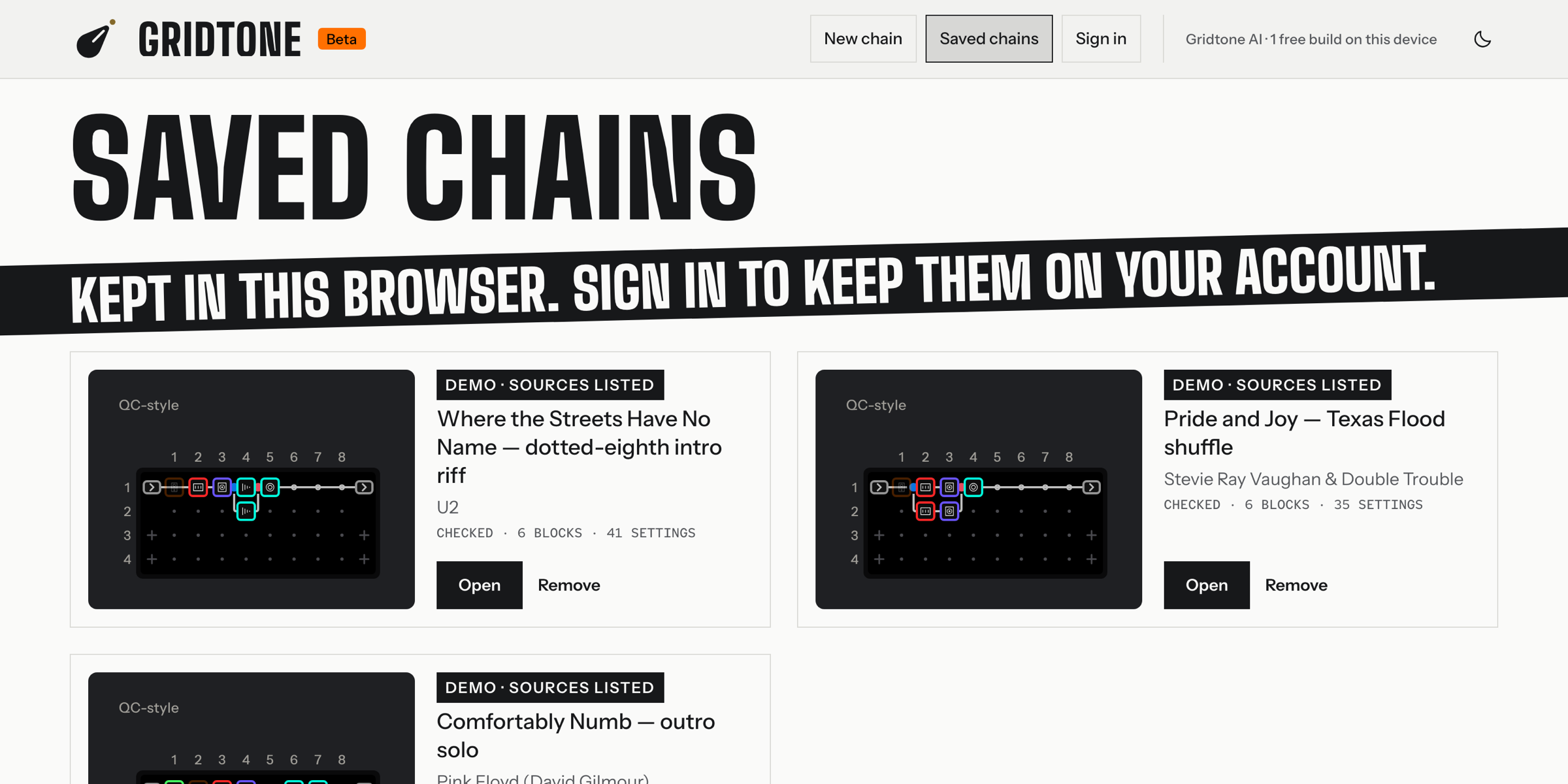
Saved chains on gridtone.app, each with its plate. Signed out they stay in the browser; signed in they live on the account.

Decisions log

The calls that shaped it, reversals included. Most of them are about what Gridtone refuses to do.

01
Check every chain against a catalog before showing it

Instead of: Trust a well-prompted model to stay inside the unit

A model will always invent a setting sooner or later. A check can't be talked out of the catalog, and it lists what it changed.

02
Spell every name the way the unit prints it

Instead of: The names on Neural DSP's online device list

The website drops the (M) and (ST) the unit shows, and a player looks for a block by the name on their screen.

03
A free tier on my key, with a reservation per build and a daily cap

Instead of: Unlimited free builds, or a paywall before the first chain

A player has to hear the product before paying anything. I have to know the worst day costs a known amount.

04
Bring your own key, kept in the browser

Instead of: Send players' keys through Gridtone's server

A key Gridtone never receives is a key it can never leak.

05
One free build per browser, then an optional Google account Reversed

Instead of: A free build every day on every browser

A browser makes up its own ID, so a daily build per browser was easy to abuse. One build shows what Gridtone does. An account gives a player who comes back five a day.

06
Saved chains live on the account Reversed

Instead of: Saved chains kept only in the browser

Once there was an account, a chain saved on the laptop and missing on the phone was a broken promise.

07
The B4 redesign, poster type and a tilted ink band Reversed

Instead of: The first identity, quiet paper and graphite

It was correct and forgettable. The faceplate and the grid stayed calm. Everything around them got loud.

08
The wordmark drawn from Big Shoulders capitals Reversed

Instead of: The first identity's wordmark, Red Hat Display in lower case

Once text moved to Instrument Sans and titles to Big Shoulders, the wordmark was the last Red Hat Display on the site, kept only because it came first. Drawn as outlines it speaks with the poster type, loads no font, and still fits a 320px phone header.

09
Agents never edit the brand guide, the foundation or the tokens

Instead of: Let a fixer change whatever makes its review pass

The rules are what the work is checked against. They can't belong to the thing being checked.

10
The model plans the scenes before the blocks Reversed

Instead of: Blocks first, scenes after

Written blocks first, a chain's scene notes said a pedal was off while no block was. Scenes first, every scene has to differ in its blocks, and the check flags the ones that don't.

The reusable playbook

01
Make the promise testable

"If it's on the grid, it's on your Quad Cortex" is a promise a player can check on their own unit in a minute. It keeps the product honest, and it keeps me honest about what the check can't prove: that the tone is right for the song.

02
Price the free tier before you design it

A free tier on your own API key is a cost model first and a screen second. Decide the reservation, the daily cap and the limits, then write the sentence the player reads when they hit one.

03
Keep the rules out of the agents' reach

Agents optimise for passing. If the brand guide, the tokens or the tests can be edited by the thing under review, sooner or later they will be. Let agents propose a rule change, and make it yourself.

04
Redesign the moment it bores you

The first identity was correct and forgettable. Changing it on day eleven cost two days. Shipping something I found uninspiring would have cost more.

Fifteen years of designing products for other people's problems. Gridtone started with one of mine, with a guitar on my lap. It's in beta at gridtone.app, and the check is there for you to test on your own unit.

Ask the archive

Grounded in this site’s case studies and journal. It says when it doesn’t know. Questions are recorded so Loïc can see what the site fails to answer. Nothing else is stored.

About this assistant ↗