Work
EN FR
Case Study · LiteFarm · 2024 · 11 min read

835 farms in 114 countries use it. I knew nothing about farming when I started.

How depth interviews across five continents turned a terrifying unknown domain into an animal-management feature now used across LiteFarm every day. Hired solo to research, define, and design it, start to finish.

Client
LiteFarm
Role
Lead Product Designer (Solo)
Year
2024
Disciplines
UX ResearchInformation ArchitectureProduct DesignMobile DesignAgritech
835 farms in 114 countries use it. I knew nothing about farming when I started.

Livestock farmers across 835 farms in 114 countries now manage their animals in LiteFarm.

They add animals one by one when they know each by name, or in batches when they run a flock of hundreds. They track births, movements, treatments, and the full arc of an animal's life, from a phone, in a field, often with no signal. The feature shipped, it's in daily use across the platform, and the feedback from farmers and stakeholders has been the best of my career.

When I was hired to build it, I knew nothing about farming.

I was brought into LiteFarm specifically to lead the animal-management feature, and within weeks the product lead left on several months of parental leave. The high-level specs he'd compiled were solid but deliberately open, and the domain was genuinely intimidating. Sustainable agriculture, livestock husbandry, the working reality of a rancher's day, none of it was mine. It was down to me to start somewhere, alone, in a field I didn't understand.

So I did the only thing that has ever worked for me in an unfamiliar domain: I stopped pretending I knew, and I went to the people who did. The first thing they taught me was that the team knew its own users less well than it thought, the app was built mobile-first, but the farmers were on laptops. That set the tone for everything after: check the assumption, then design for what's real. Farmer-driven research turned a terrifying blank page into a feature real farmers now rely on, and it's the clearest proof I have of a belief I've built a career on, that the craft of design transfers across any domain, if you're willing to do the work of understanding the people in it.

I couldn't design for farmers I didn't understand, so before proposing anything I made myself a student of the domain and of our users.

I started inside LiteFarm itself: studying the existing app, talking to every stakeholder, digging through earlier feature requests, and reading every survey, farmer interview, and scrap of material I could find that touched animal management. Combined with the product lead's specs, this gave me a first real picture of what a sustainable-farming animal feature needed to be.

Then I went to the field. I scripted and ran depth interviews with livestock farmers across five continents, chosen deliberately for the spread of their needs, their animals, and their scale:

  • A top organic ranch in Canada, open land, cattle, pigs, and chicken in high numbers.
  • A breeder of a near-extinct pig breed in Ontario, with some cattle alongside.
  • A goat breeder in rural Ireland, producing goat cheese.
  • A cattle farm in rural India, producing ghee and other milk products.
  • An organic farming cooperative in Brazil.
  • A large-scale rancher in the USA.

Collective interviews and digital surveys sent to our existing user base rounded out the data. The range mattered: a farmer naming a near-extinct pig breed and a rancher running thousands of head of cattle do not need the same tool, and designing for only one of them would have quietly excluded the other.

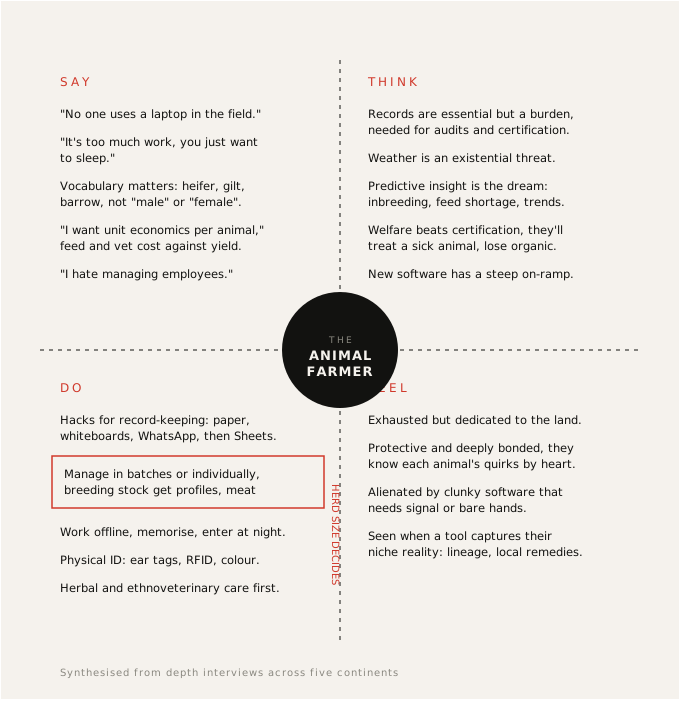
Empathy map synthesising what livestock farmers say, think, do, and feel, drawn from interviews across five continents

Interviews only matter if they change what you build. Mine changed the architecture of the feature at its root.

I built five personas, separated by goals and by herd size, and pulled an empathy map from the interviews to hold what animal farmers say, think, do, and feel in one shared view. Two findings did the heavy lifting.

Some farmers bond with individual animals. Others see only a batch. A breeder who can name a near-extinct pig and knows its lineage needs a profile per animal. A rancher running a flock of hundreds of meat birds needs to manage them as a group, and would be punished by a tool that forced one-by-one entry. This wasn't a preference to accommodate, it was a fork in the data, and it depended almost entirely on herd size. It became the spine of the whole module: the ability to add and manage animals as a unique individual or as a batch, first-class, from the start.

Farmers already have a system, and it's paper, spreadsheets, and WhatsApp. Most were working from logbooks or Google Sheets, coordinating with their team over WhatsApp, which turned out to be remarkably common in farming worldwide. They memorise events in the pasture where there's no signal, and enter data at night. Any tool that ignored that reality, that assumed a laptop and a connection, would simply not be used.

A competitive benchmark sharpened the picture further. I assessed the industry-standard animal-management apps for patterns worth emulating and gaps worth exploiting, and found that most of them are expensive. LiteFarm, being free and open-source, had a structural advantage: it could serve the farmers those tools priced out, if the experience was good enough to earn the switch from paper.

STAGE 01

Mobile-first, for users who weren't on mobile

The problem
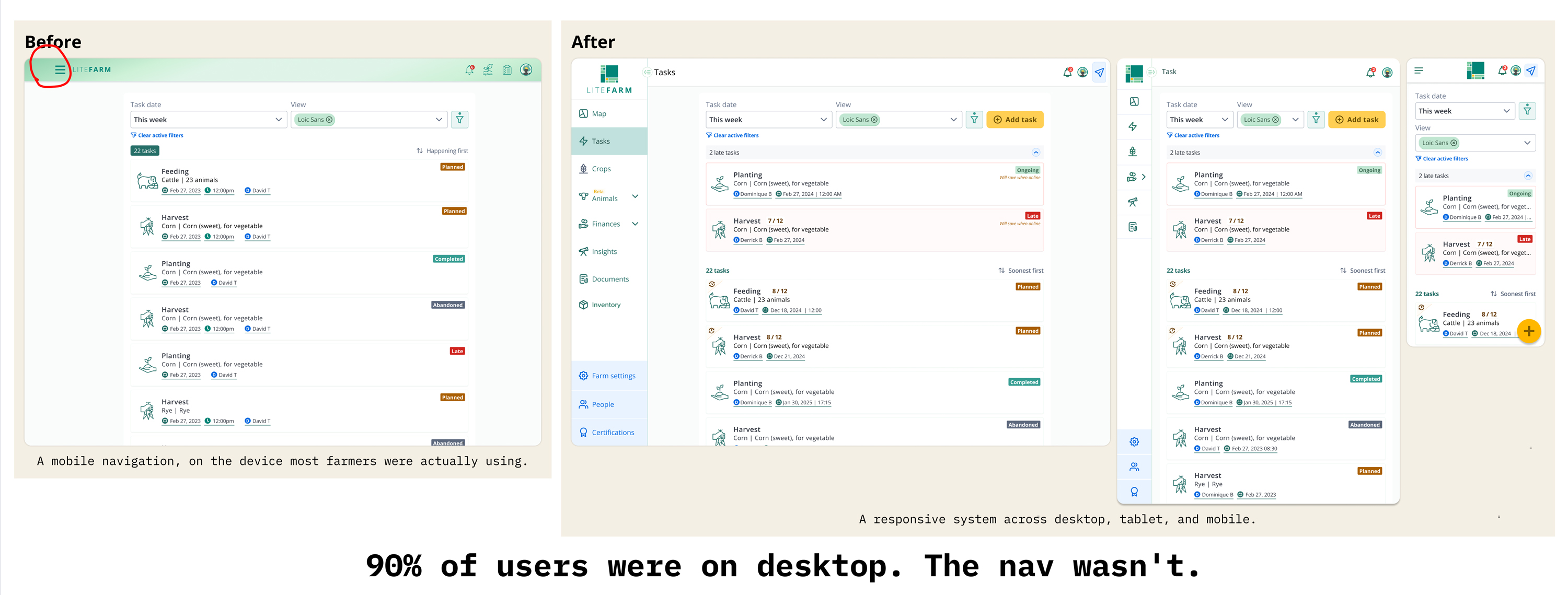
The whole app was built on a wrong assumption. I was hired into a mobile-first mandate: the product, the design, even the desktop navigation were built mobile-first, the desktop simply wore a mobile nav. But the assumption was wrong. The analytics told a different story, roughly 90% of users were on laptop browsers, and every single interview I ran confirmed it. LiteFarm was optimised for a device most farmers weren't using.
The method
I checked the mandate against the data, saw the desktop reality, and confirmed it in every farmer conversation. Then I re-architected the foundation the animal feature would actually need. A new sitemap, so the module had a logical home instead of being bolted on. And a dedicated, fully responsive navigation system across desktop, tablet, and mobile: a reorganised cross-device nav, an admin side navigation, a thumb-friendly mobile nav, and desktop-specific map interactions, with documented hover, active, and sub-menu states and animated transitions. It was substantial enough that we shipped it as its own release to keep things manageable. None of it was in the original animal-feature brief.
I own
The judgment to override a founding company assumption with evidence, and the decision to fix the foundation before building the feature I was hired for. The responsive navigation system end to end: every breakpoint, every state, the sub-menu behaviour, and the motion. The sitemap redesign. The call that a feature is only as good as the architecture it lives in.
The result
A navigation and information architecture that finally matched how farmers actually work, on the device they actually use. The work shipped as a dedicated release in January 2024, announced in a public post I researched, designed, and wrote myself. A correction that improved the whole app, not just the feature I came in to build, and the groundwork that made a coherent animal module possible at all.
The responsive navigation system across desktop, tablet, and mobile, replacing the original mobile-only nav, with documented states and transitions
STAGE 02

One animal, or a thousand

The problem
The research had made the core requirement non-negotiable: the feature had to serve the breeder who names every animal and the rancher who runs them in flocks, without compromising either. Two mental models, one module.
The method
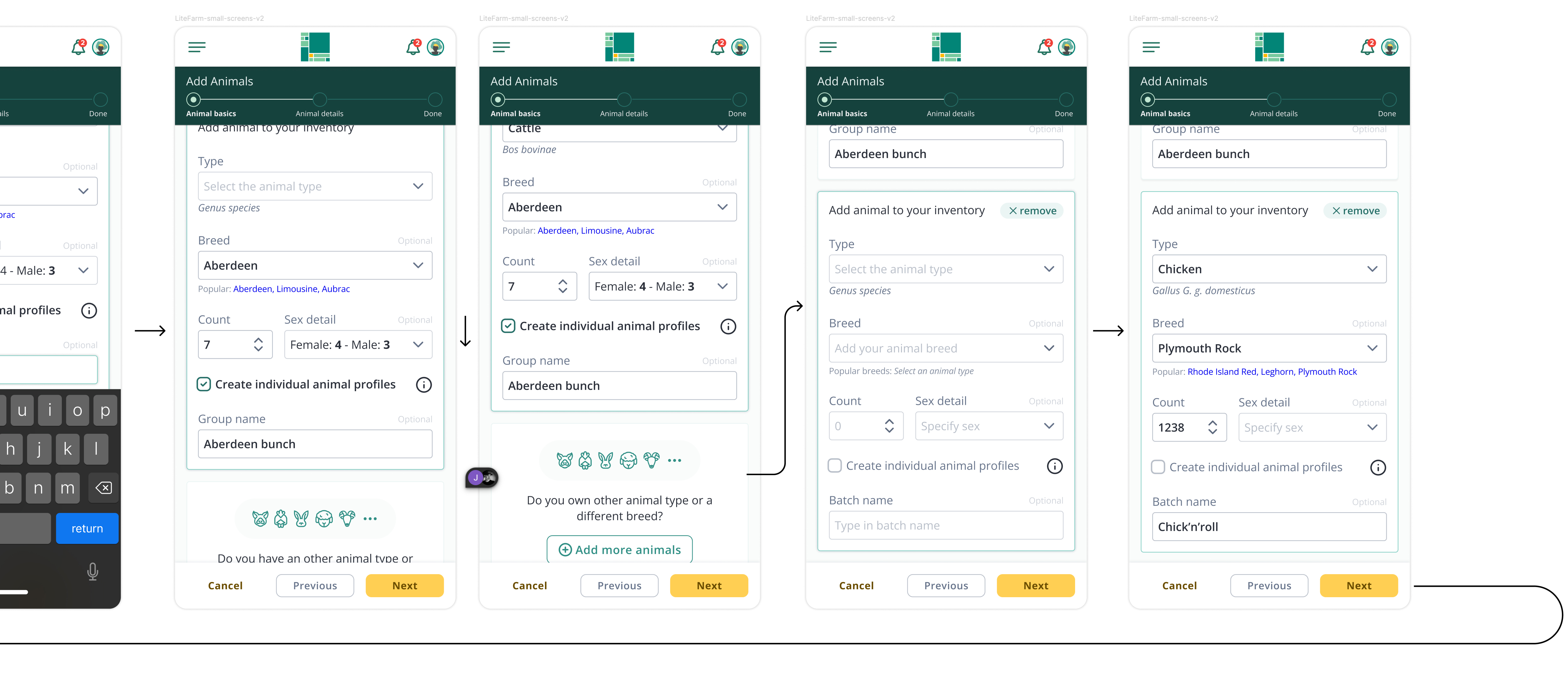
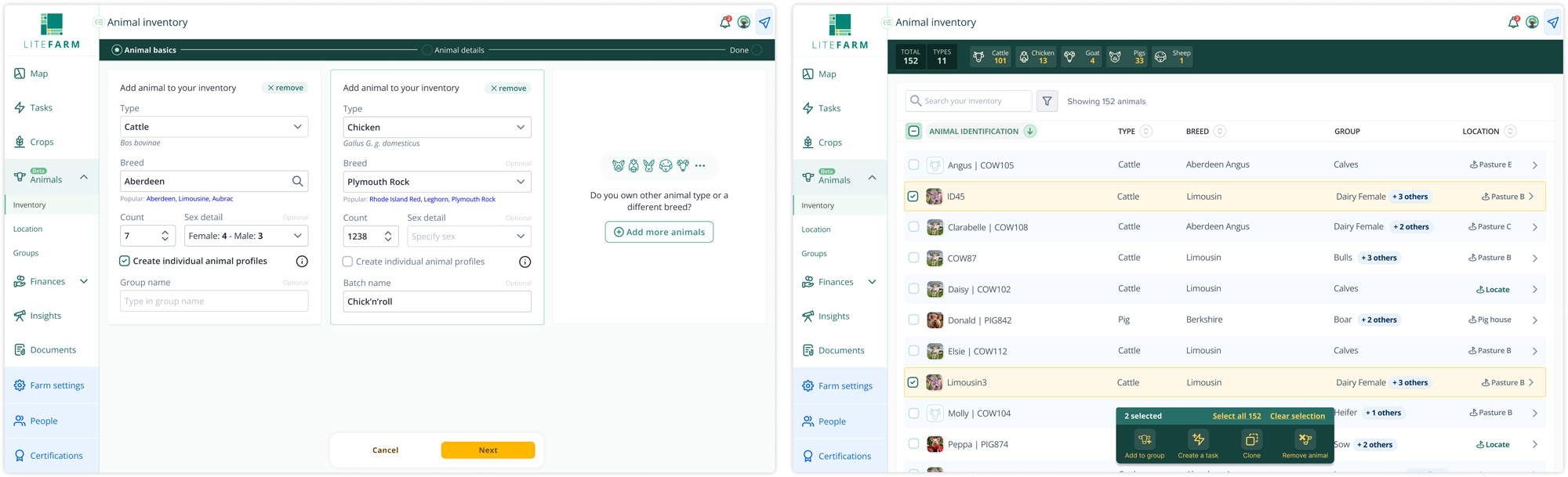
I designed the inventory module around a first-class choice between adding a unique animal, with its own profile, lineage, and history, and adding a batch, managed as a group. The flows share a spine but respect the difference: individual entry supports the detail a breeder needs, batch entry supports the speed a large operation needs. Everything was designed mobile-first, for one hand, in a field, because that's where the data actually gets entered.
I own
The interaction architecture of the add-and-manage flows, the unique-versus-batch model, and every decision about what a farmer sees first versus what waits behind a tap.
The result
An inventory module that fits both ends of the spectrum. Both modes are in active use, which is the proof the research call was right, not just clever.
The add-animal flow showing the choice between adding a unique individual and adding a batch
STAGE 03

The whole life of an animal

The problem
Adding an animal is the easy part. Farmers needed to manage the full lifecycle, births, movements between groups and locations, treatments, status changes, and the end of an animal's life, each with its own data, states, and edge cases.
The method
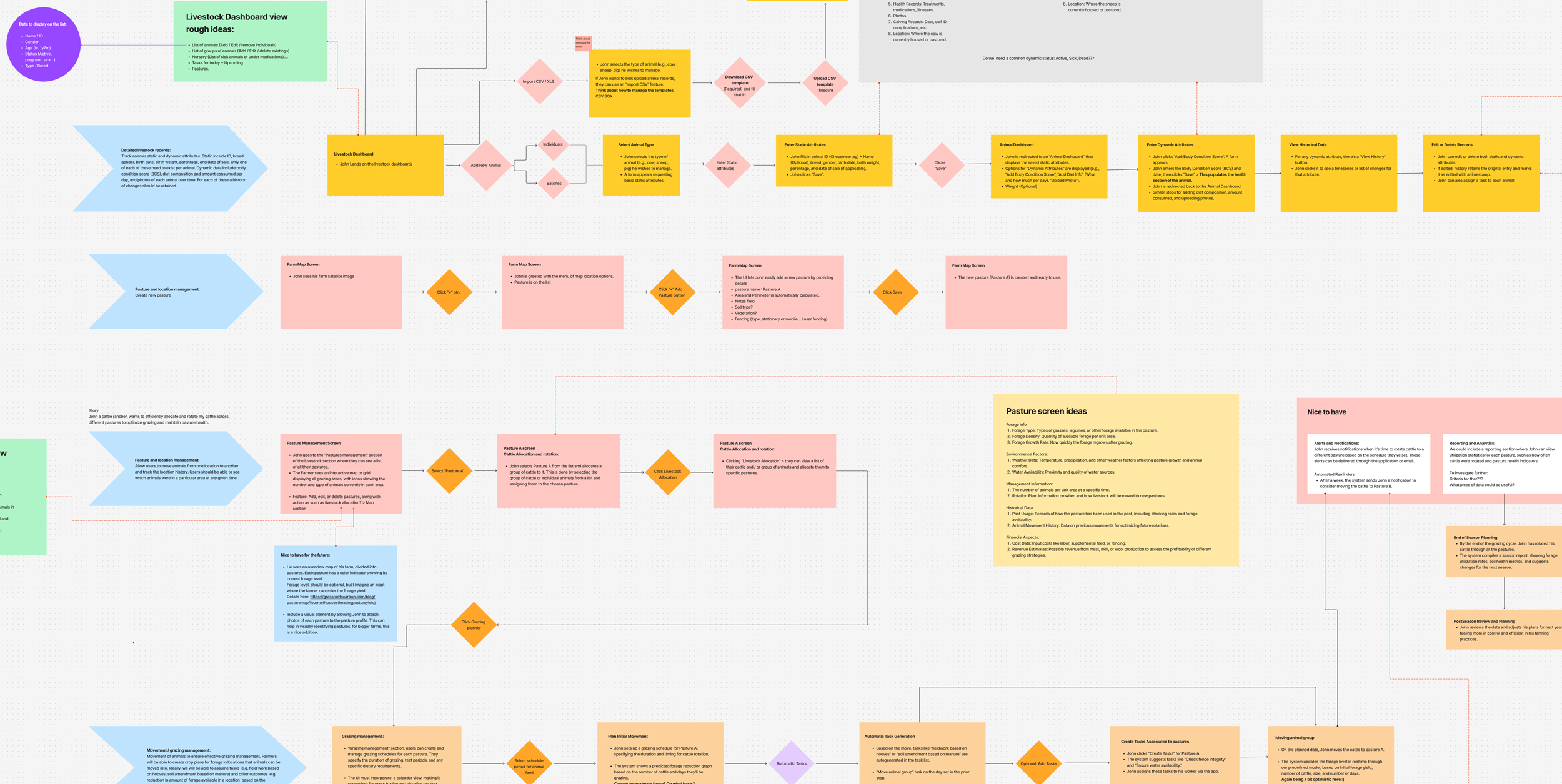
I designed a full end-to-end animal-management workflow covering the complete lifecycle from birth to end of life, documented down to key metadata, UI, and screen states. The workflow maps how animals move through the system over time, so the feature holds up not just at first entry but across the years a farmer actually uses it.
I own
The entire lifecycle workflow, the state model behind it, and the handoff documentation that let engineering build it as designed.
The result
A documented workflow deep enough to build from and complete enough to cover the real, messy lifecycle of livestock, not just the happy path of adding a new animal.
The full animal lifecycle workflow, from birth to end of life, with metadata and screen states
LiteFarm · 2024

Here is the part I was told, when I started, that I had no business attempting. I knew nothing about farming, and I designed a livestock feature now used across 835 farms in 114 countries.

But the number isn't the proof. The proof is that the two farmers at the opposite ends of everything the research uncovered are both served by the same feature, and neither was compromised for the other.

Take Tristan and Aubyn, in British Columbia. They run hundreds of pigs and thousands of chickens, and for them, individual animals are neither trackable nor relevant. "During the summer we'll raise about 4,000 chickens, but those are tracked per batch, the whole 2,000 in one go. Any mortalities, feed numbers, slaughter data, it's all tracked for that flock." When I asked how they identify animals, the answer was blunt: "I don't have an animal ID for each one of those pigs. I just have an animal ID for that group of pigs, and I use the invoice number." What they needed from software was the ability to add forty hogs and be done: "I don't even really know or care which ones are male or female. I just need to be able to save the whole thing with no details."

Now take Sara, in the west of Ireland. She keeps six dairy goats, maxing out at ten, and knows every one by personality. "A bottle fed goat is like a dog, and a parent fed goat is like a goat." For her, the individuality is the point, and it's exactly what she finds missing in farm software: "There's not a lot of room for that individuality. I like that this app is more for niche farms, that there's that bespoke nature to it." When she used the prototype, she reacted to the precise thing the research had told me to build: "You have the animal's name and their tag number right there. That's awesome."

Tristan needs to save forty hogs with no details. Sara needs her goats' names on the screen. The interviews revealed that fork, herd size decides which side of it a farmer lives on, and the feature holds both without forcing either to bend. The breeder who names every animal and the rancher running flocks of thousands are both in the product, both served, exactly as the research said they'd need to be.

That is what I mean when I say the craft transfers. I did not become a livestock expert. I became a good enough student of livestock farmers that the thing I designed fits their lives, whether they run six goats or four thousand chickens. The domain terrified me at the start. The process, research, synthesis, the discipline to let farmers' reality drive the decisions, is what carried me from zero to a feature they rely on. Drop me into a domain I don't understand, and this is what I'll do in it.
What it delivered

Live and in daily use

The animal-management feature shipped and has been used by 835 farms across 114 countries.

The research call, vindicated

Both the unique and batch modes, the fork the interviews revealed, are in real production use: farmers have recorded nearly 9,000 individual animals and over 1,100 batches. The six-goat micro-farm that manages by name and the operation running thousands of chickens by batch are both served. The core architectural decision was proven right by the users themselves, in the data.

A domain, learned from the people in it

From zero knowledge of sustainable agriculture to a feature livestock farmers rely on, built by making myself a student of farmers across five continents. Proof the craft transfers.

A validated roadmap, ready to build

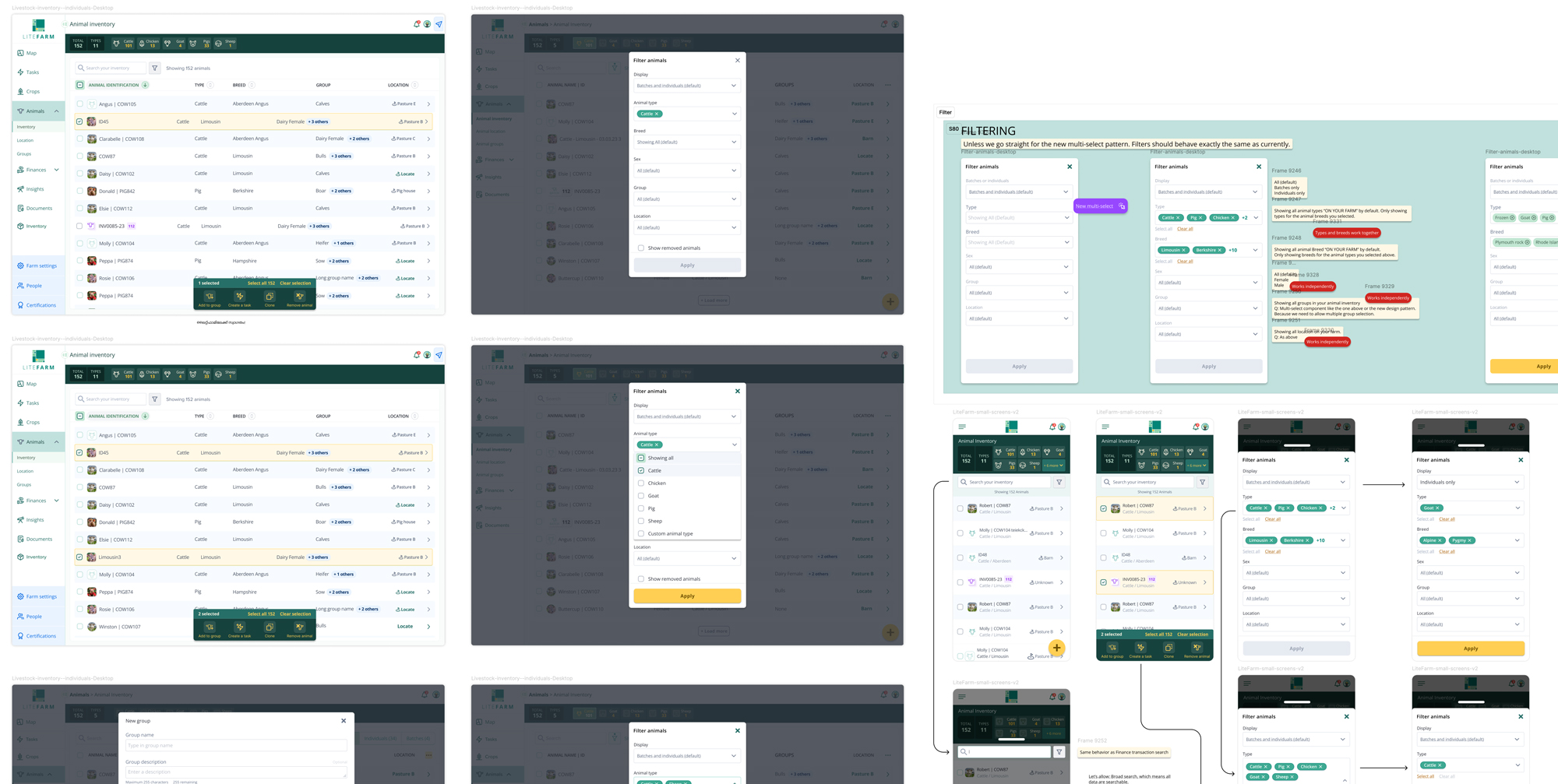
The feature is still in beta. I've designed many further workflows around it, not yet built for budget reasons, so there's a validated backlog of animal-management features ready to ship as funding arrives.

Overview of the documented animal-management workflows delivered to engineering

I'll be straight about where this stands: the feature is live, loved, and still officially in beta, with a backlog of designed-but-unbuilt workflows waiting on funding that's now on the way. That's not a caveat, it's the honest state of a real product, and I'm sitting on a validated roadmap most teams would envy. The thing I'd want you to take from this isn't the agritech domain. It's that I was dropped into a field I found terrifying, and farmer-driven research carried me to a feature 835 farms across 114 countries rely on. Give me a domain I don't know yet. That's exactly the problem I like to solve.

Ask the archive

Grounded in this site’s case studies and journal. It says when it doesn’t know. Questions are recorded so Loïc can see what the site fails to answer. Nothing else is stored.

About this assistant ↗