Work
EN FR
Case Study · Farmscribe (independent project) · 2026 · 8 min read

What farmers know but never write down

Farmscribe turns a farmer's field notes into structured records and advice that knows the farm. It started as a buried line in a Jira ticket. It's now a live app, in invite-only beta at my.farmscribe.app.

Visit the live app ↗
Client
Farmscribe (independent project)
Role
Founder, Designer & Builder (Solo)
Year
2026
Disciplines
R&DAI ProductUX & InteractionMobile UXAgriculture0→1 Product
What farmers know but never write down

The smartest line in a Jira ticket

At LiteFarm, an open-source farm platform, I'd scoped a Farm Notes ticket down to a simple digital noticeboard. Buried in the "for later" section was one throwaway line: AI could auto-create tasks from notes. It never shipped there, LiteFarm had no AI budget for it. It became Farmscribe instead: a mobile note taker, built AI-first with a sustainable-agriculture domain partner, that turns a quick field observation into a structured record and advice grounded in the farm's own history. What follows is the short version of how it got from that line to a live app now in invite-only beta.

LiteFarm's constraints were real: no AI team, no AI budget, a careful governance process. The idea was right, the address was wrong. Spinning it out wasn't rebellion, it was the only way to build AI-first without asking permission for every decision.

LITEFARM FARM NOTES · PRODUCT SPEC
2023
ORIGINAL TICKET

"As a user I want to be able to share some observations or take quick notes around the farm"

As requested by multiple users, this is the feature for a separate section on the sidebar that works like a farm noticeboard. The minimizable sidebar could exist alongside the new planned insights dashboard. Please use existing free libraries wherever relevant to avoid building from scratch.

Eg: Broken fence, Goat Dolly due for vaccination next Thur, Coyote sightings in the area - keep the goats locked after 5pm, Researcher Dave visiting Mon, Fill fuel

These may or may not be actionable, so they need not necessarily have an owner or a due date.

Must have: It is a simple note publish feature with a simple long text, upload media and publish. It is largely like a whiteboard one might have in their barn or shed, with an additional ability to add notes to self. This is not intended as a 1-1 chat, nor a task, but we might potentially expand it based on how the feature is working out.

Enabled functions: to begin with: For author, delete. For others, just view.

Initially, the notes can just be private (note to self) or public (like a noticeboard in barn). All published notes must appear in reverse chronological order along with the author's name and date.

To begin with, we can support historical notes up to a month, with archiving possible for up to 6 months in the past. If the notes are beyond 25MB or over a month, we encourage owner to archive to be able to continue using the notice board.

Open point: Not sure if it makes sense to associate a field / location to a note?

Great to have: When someone publishes a note to the noticeboard, a notification goes to all the members of the farm. Ability to delete posted note. Members can react with basic few emojis. A note can also be accompanied by one picture (jpeg / png). On mobile, can upload or open camera.

Unsure of: download content of noticeboard.

Success criteria: %Usage = Number of farms using the farm noticeboard / Total number of true farms. If the % of farms using noticeboard is ≥15% of active farms, then the feature is considered successful.

For later scope: Based on user feedback, we can plan for specifically tagging people, creating tasks or custom tasks from notes. Depending on success of the feature, we could have AI join the chat and auto-create custom tasks from notes. For example, someone notices broken fence, AI can create a custom task "Fix fence". Possibility of moderation of posted content. Possibility to respond 1-1.
Text note + optional photo
Public noticeboard or private note
Reverse chrono · author + date
Author deletes · others view only
Not a task. Not a chat.
≥15% farm adoption = success
FOR LATER SCOPE · THE SEED

"Depending on success of the feature, we could have AI join the chat and auto-create custom tasks from notes. For example, someone notices a broken fence, AI creates a custom task 'Fix fence'."

The problem wasn't a missing noticeboard. It was that a farmer's best observations evaporate before they're useful. Aphids on the carrot bed, mentioned once, forgotten by the time they're an infestation. The fix isn't just logging, it's logging that gives something back. Tell the app what you saw, it structures the note and hands back advice. Logging stops being a chore and starts being a conversation.

The AI-enhanced pipeline

Four stages. One principle: earn the right to add complexity before adding it.

STAGE 01

Finding the idea

The problem
A real feature at LiteFarm contained the seed of a different product. Early exploration then threatened to bury it again under a full platform vision, three user flows, activity logging, task delegation, before the core loop had proven anything.
The method
Pulled the buried line out and mapped what a single AI call per note could unlock, task extraction surfaced as the highest-value, lowest- cost starting point. Then applied a strict earned-right cut: three flows became one, platform ambitions became Phase 2, the MVP reduced to capture, structure, advise, save.
AI handles
Claude helped refine the spec, surface edge cases, and pressure-test scope decisions, flagging the offline-plus-AI contradiction early.
I own
The decision to spin Farmscribe out as a standalone product. The judgment that task extraction beat summarisation or moderation as the first AI hook. Every cut, knowing what farmers need first versus what looks good in a pitch isn't a prompt's call.
The result
A standalone product, not a feature, with a focused MVP scope and a decisions log kept live from day one.
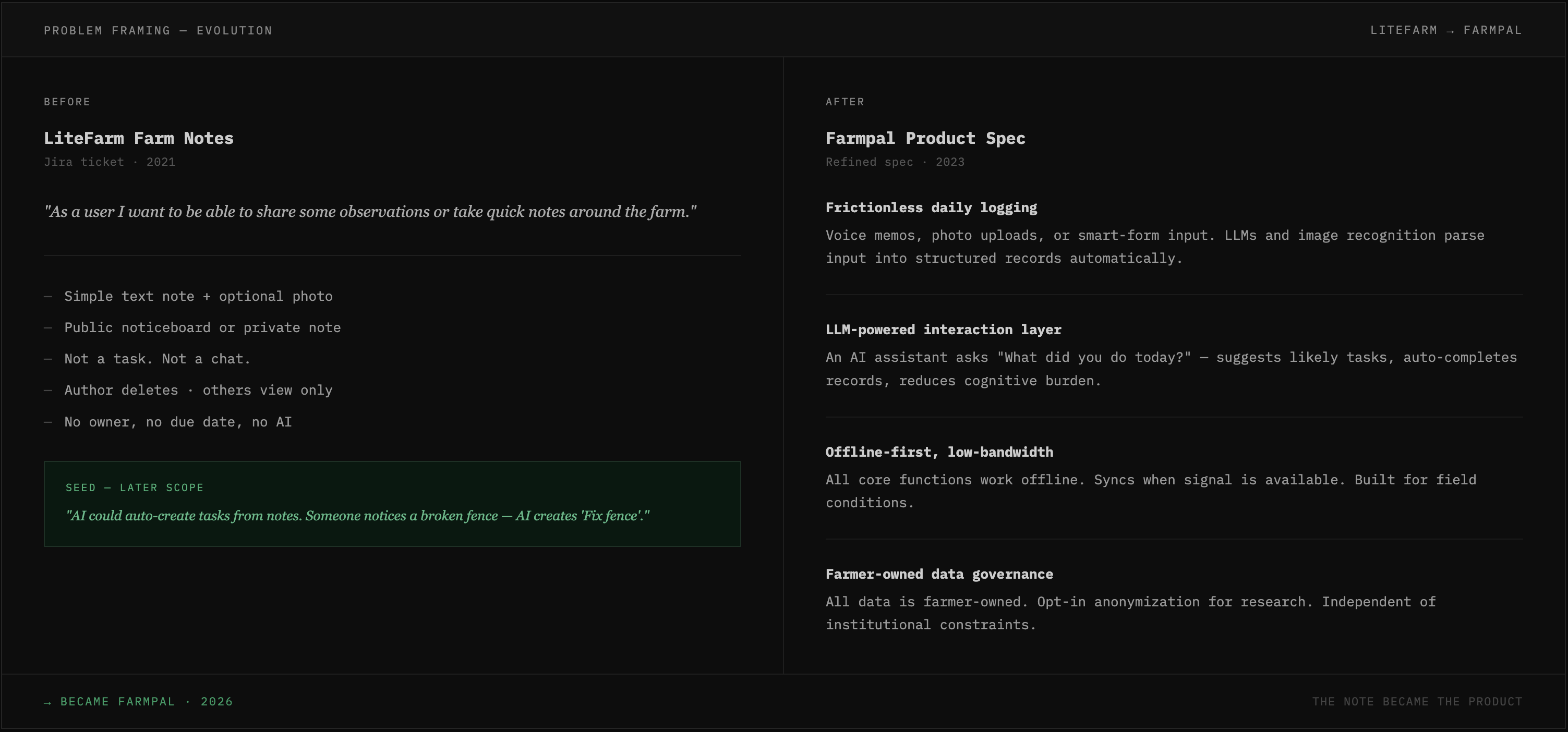
The original LiteFarm Farm Notes Jira ticket alongside the refined spec, the before and after of the problem framing.
STAGE 02

Building the loop

The problem
A working prototype and a production-quality one aren't the same bar. The spec needed to become something testable, then something real, without a backend to lean on at first.
The method
Built the whole loop as a single self-contained React file: capture by type, voice, or photo; publish-first AI advice and a suggested task, resolved into a shared team log. Then hardened it, full accessibility, a live Claude call replacing the mock, native speech-to-text, and, after a cost audit found the 3,510-line file itself was the biggest tax on every session, split into thirteen focused components before touching the backend. Finally wired a real Supabase project, Postgres with row-level security, real Google sign-in, with a local-first migration so starting free never means starting over.
AI handles
Claude wrote and iterated the prototype, built the AI-status components and the live integrations, and ran the cost audit that changed the decision, split the file before the backend, not after.
I own
Publish-first sequencing. Making voice the hero capture path, field- first means hands full of soil, not a keyboard. Supabase over Firebase, because farm data is inherently relational. And diagnosing a live row-level-security bug during testing.
The result
A prototype that runs the whole loop end to end, now backed by a real, secured stack. With no environment variables set it still runs exactly like the original in-memory version, set two, and it's real.
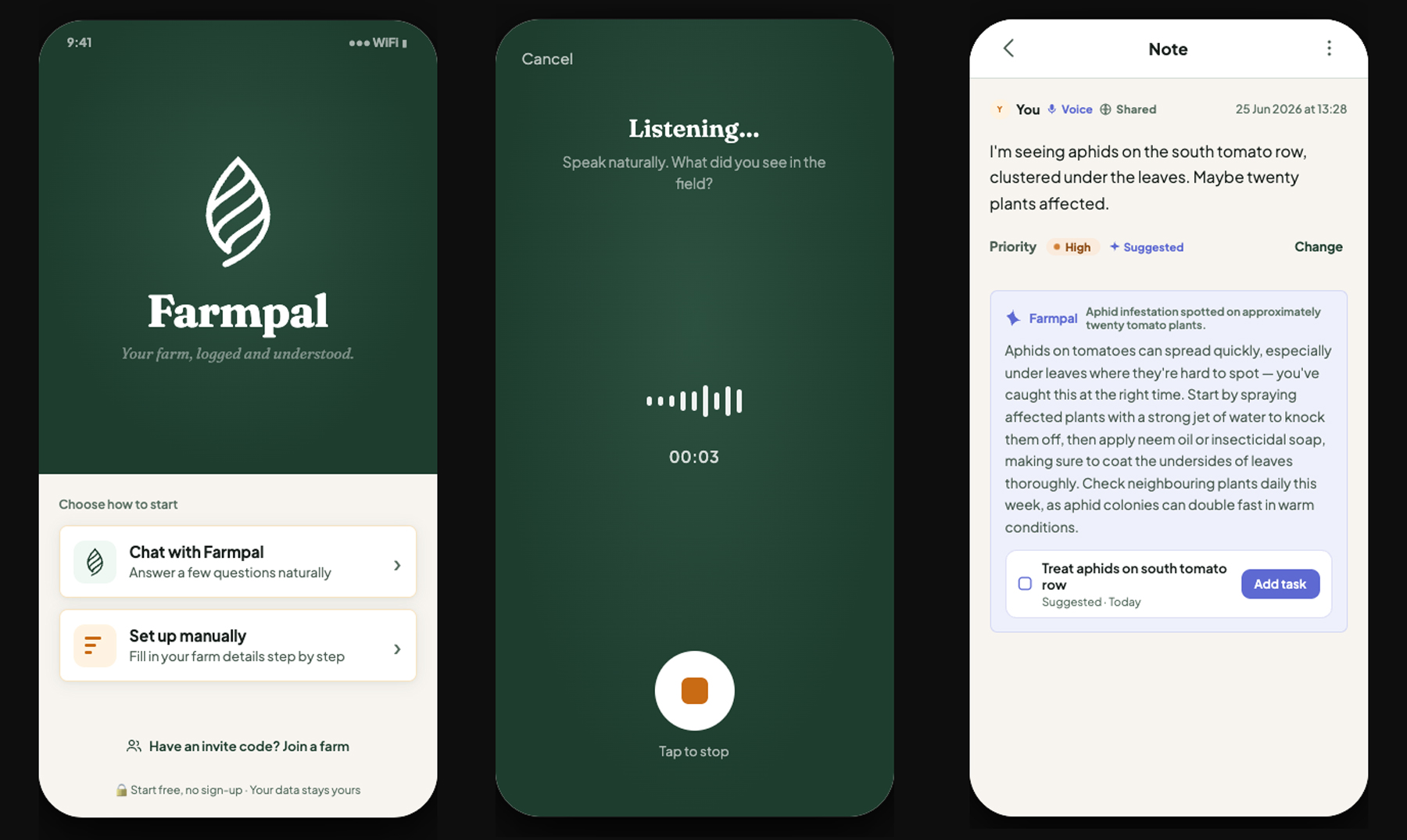
Farmscribe working prototype, voice/text/photo capture, publish-first AI advice, and a shared team log.
STAGE 03

Teaching it the farm

The problem
A note taker that returns generic agronomy is just a wrapper around a model. To earn a farmer's trust past the first wrong suggestion, the advice had to become specific to this farm, this history, this place.
The method
Instrumented metrics first, so lift could be measured, not guessed. Added a Map tab where fields are drawn and features pinned. Then layered the intelligence: advice now assembles the farm's profile and logged history into context, a calibration layer reads the farmer's own overrides as a gentle prior, and a region-and-rules layer refuses to name an input unless it's legal where the farm stands. All context engineering around a fixed model, not fine-tuning.
AI handles
Claude built the metrics pipeline, the map system, and the context- assembly seam, and caught its own bug under review, a calibration error that would have taught the model the opposite of the truth.
I own
Metrics before intelligence, you can't measure lift after the fact. Prioritising the regulatory guard before scaling regions, because recommending an illegal input is a real liability. And framing calibration as a prior the model can still overrule.
The result
Advice that reads as if it knows the farm, because it does. It recalls the aphids logged three weeks ago on the same row, and won't tell a French farmer to spray something banned in the EU.
The farm-aware app, from voice capture to a note pinned to the farm's own areas, with advice that builds on the history it was built on.
STAGE 04

Ready to launch

The problem
An intelligent prototype is not yet a product a stranger can find, trust, and use in their own language. To launch, Farmscribe needed an identity of its own and an honest front door.
The method
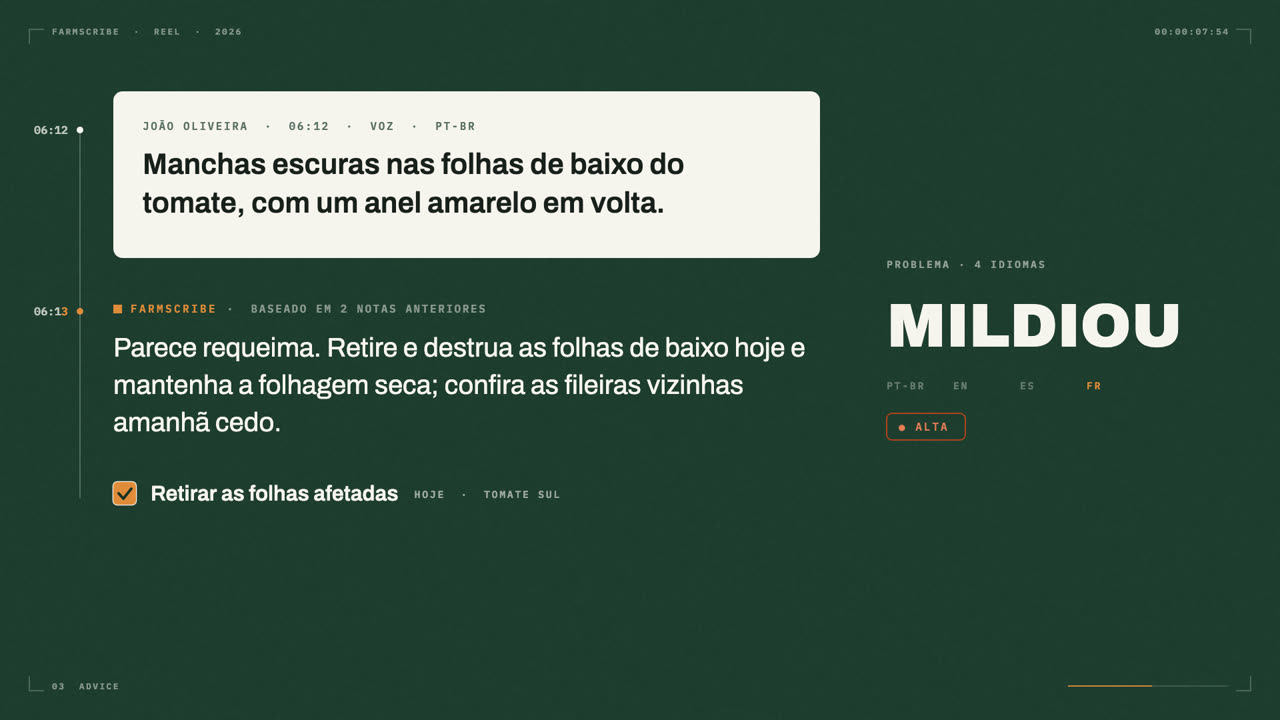
Designed the Open Furrow mark and a documented brand voice. Localised the interface into four languages, English, Spanish, French, and Portuguese, translating the chrome only, never the farmer's own words. Then rebuilt the landing page around one thesis, show the tool running rather than pitch it, with region-reflective pricing.
AI handles
Claude ran a 42-agent workflow to translate roughly 480 interface strings across eighteen screens, reviewed for brand voice and botanical accuracy, then helped build the landing page.
I own
The identity direction, the mark should say what the product does, not decorate it with a leaf. The rule that localisation translates the interface, never the content. And the landing's honesty, proof over pitch, invite-only stated plainly.
The result
A product ready to launch: a designed identity, an interface anyone can use in four languages, and a front door that shows the tool working. From a line in a Jira ticket to something ready to meet farmers.
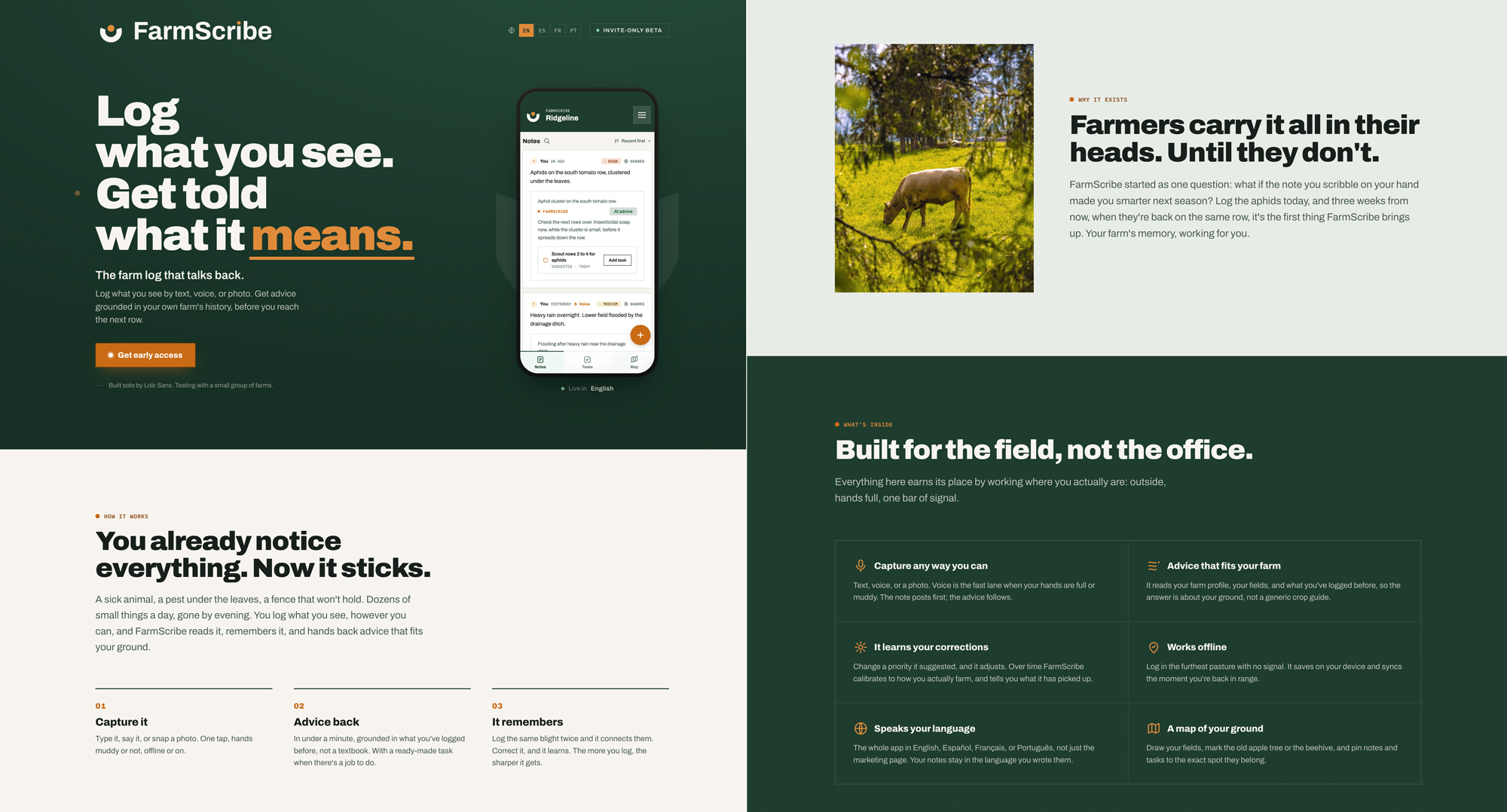
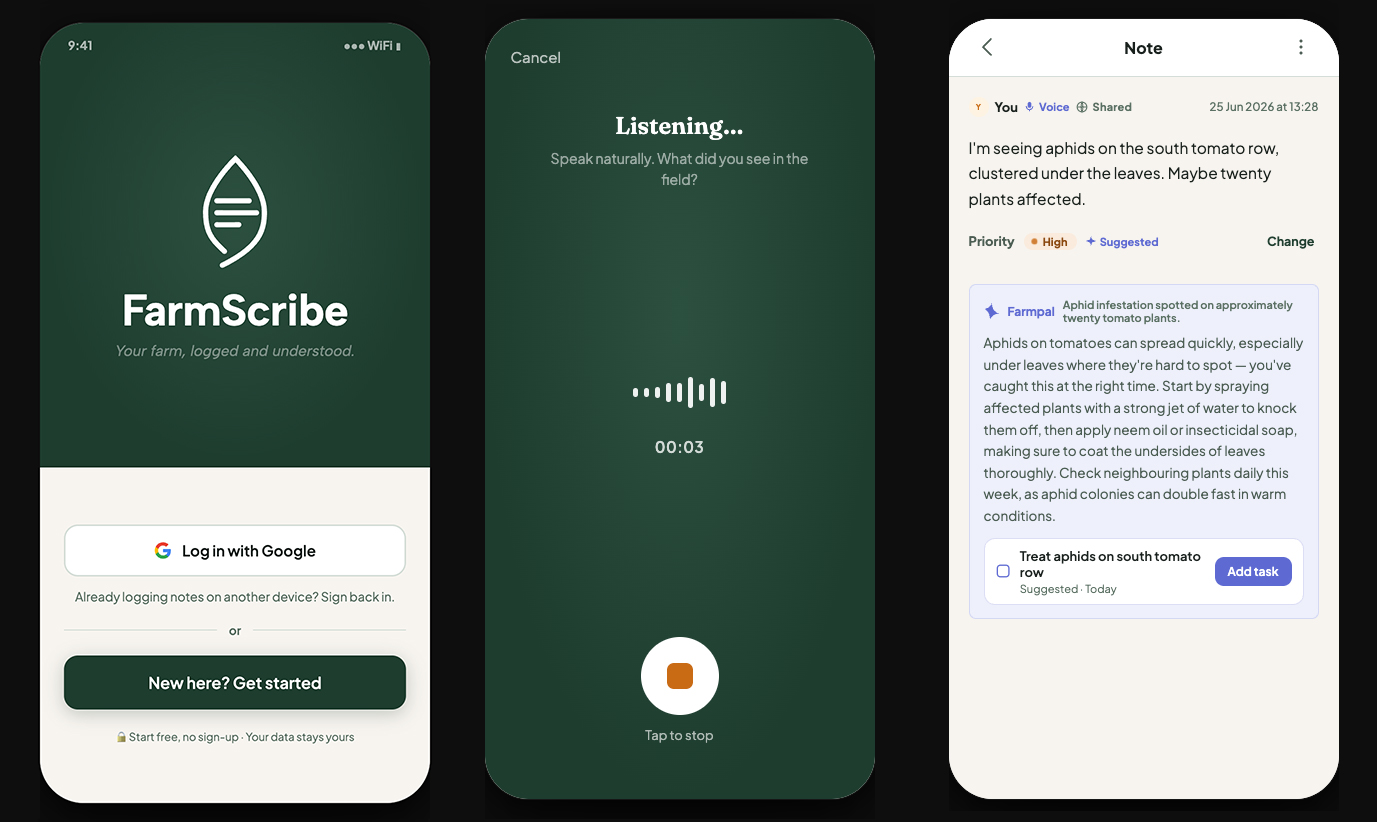
The Farmscribe landing page and the app shown in four languages, the go-to-market surface built for launch.
Farmscribe · AI Note Taker · 2026

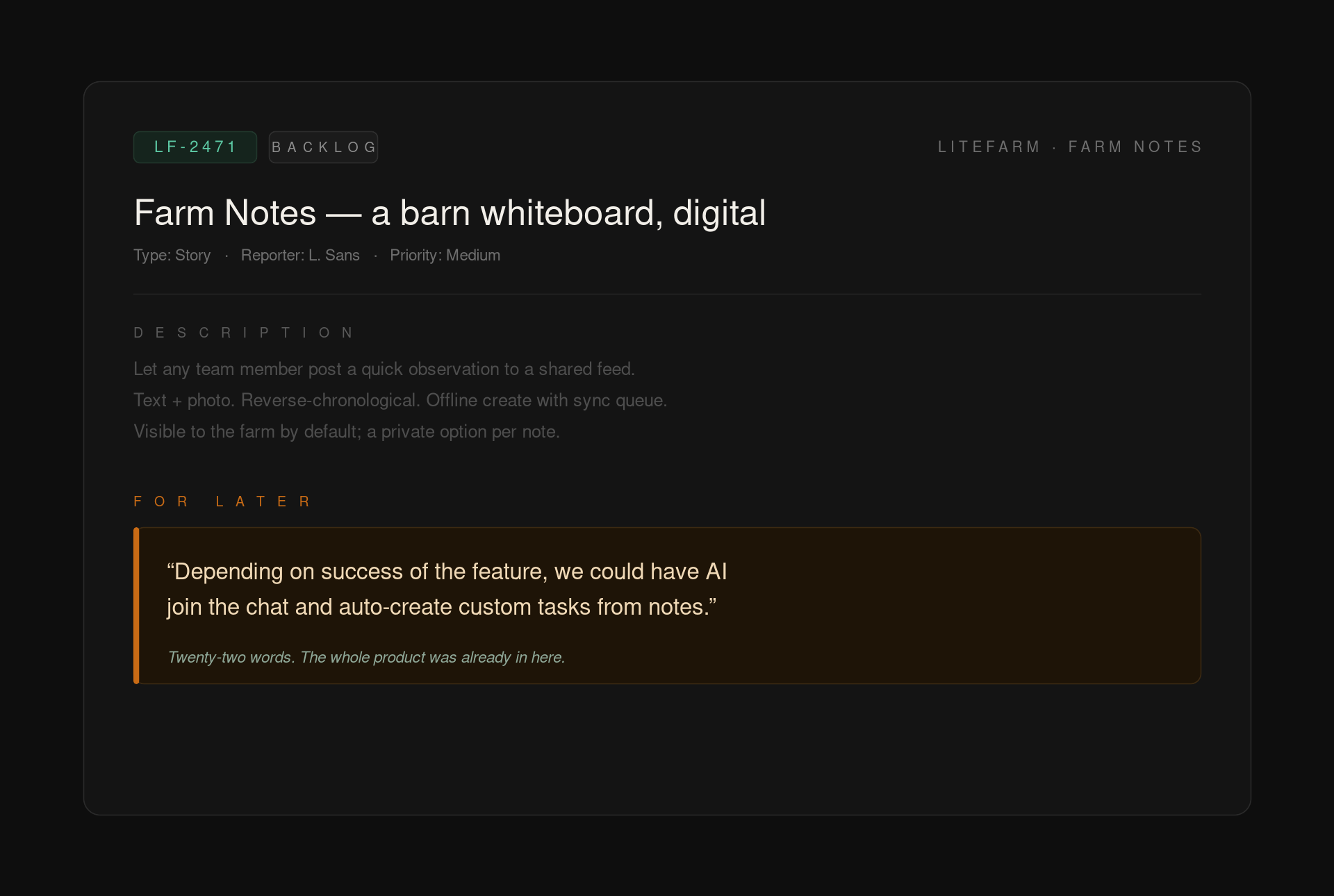
Twenty-two words in a "for later" section: AI could auto-create tasks from notes. Not a spec, a throwaway thought. But it named the real gap, what a farmer writes down and what they actually mean to do about it. The question wasn't whether AI could do it, that's one API call. It was where the advice should live. During capture, or after? Blocking, or additive? The answer: after, never during. The farmer logs an observation in under ten seconds. The AI responds when it's ready. Action first, intelligence second. That sequence is the whole product.

The original LiteFarm Farm Notes Jira ticket with the buried AI hook in the "for later" section.
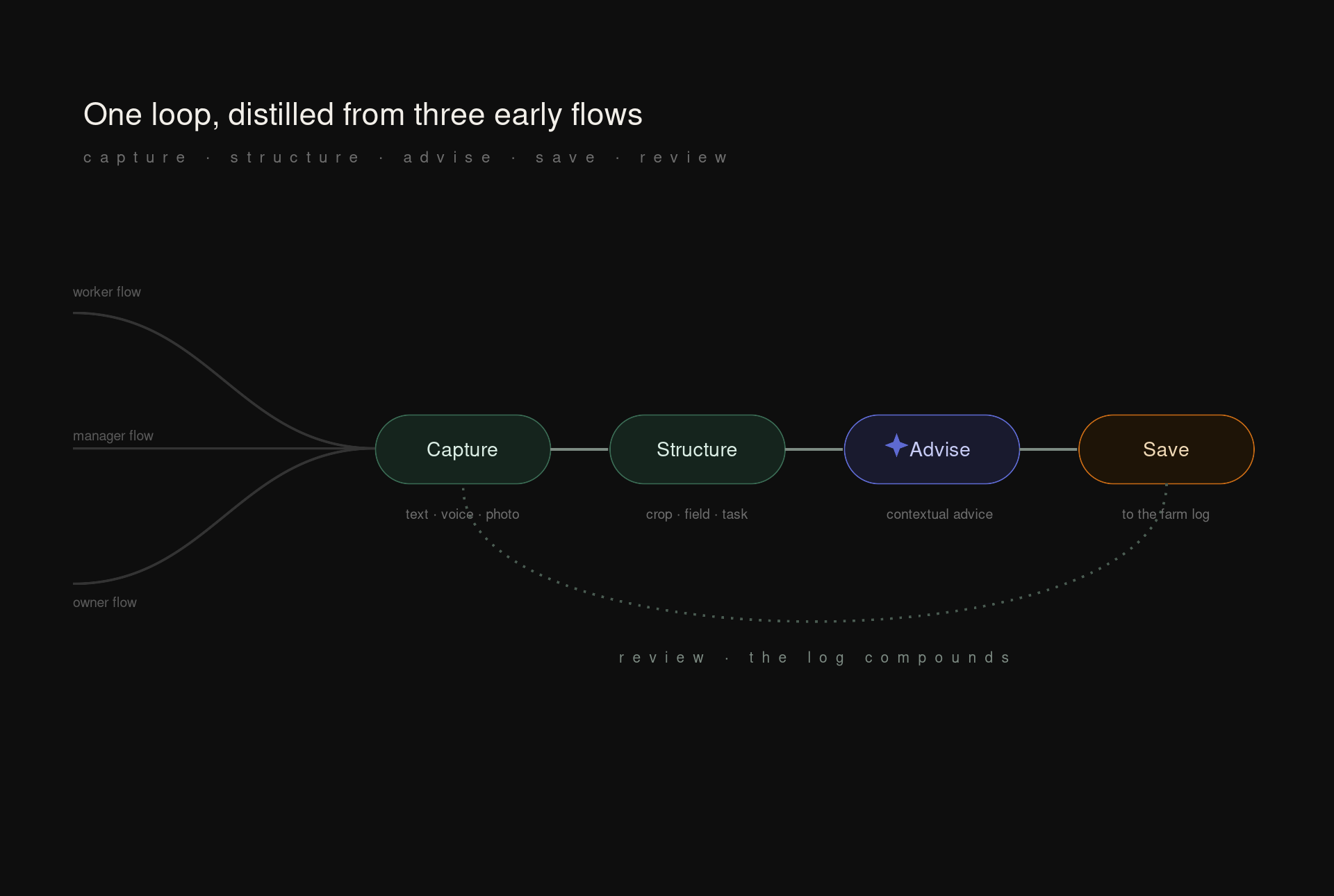
The core Farmscribe loop, capture, structure, advise, save, distilled from three early user flows.

Where AI ends and judgment begins

Farmscribe is an AI product, built with an AI assistant. Worth being honest about. Claude was fast and genuinely useful for the structural work: specs, edge cases, drafts. Every real design call, where advice should live, how to build trust with a skeptical farmer, needed fifteen years of designing for field workers. No prompt carries that. The same gap exists in the product itself. A model can't know if its advice fits this farm, this season, this soil, unless it's fed that context. That's not a bigger model, it's design: the farm's profile, its history, the farmer's own corrections, the region's rules. Context engineering, not fine-tuning, entirely human craft.

What it delivered

A live app, in beta

The full loop runs end to end at my.farmscribe.app, voice, text, or photo capture; advice grounded in your own history; tasks the AI parses from a sentence; a farm map of drawn fields and dropped pins. Four languages, real accounts, a real backend. Invite-only, and real.

Advice that knows the farm

Log the same aphids twice and it connects them. Correct a priority and it learns. It won't recommend an input that's banned where you farm. That's what separates Farmscribe from a wrapper around a model.

A designed identity, a real front door

The Open Furrow mark, a documented brand voice, and a landing page that shows the app running in four languages instead of pitching it, with pricing that adjusts to the visitor's region.

Decisions logged, reversals included

Voice, tasks, and a required farm location were all pulled in from "later" once the reasons became clear. The reversals stayed in the record instead of getting smoothed over.

The live app, a note carrying farm-aware AI advice and a suggested task, and the farm map with drawn areas, dropped pins, and the add-to-map flow.

Decisions log

The calls that mattered, and what changed my mind. The reversals are kept on purpose, in an R&D project the changes of mind are the work.

01
Spin Farmscribe out of LiteFarm as a standalone product

Instead of: Remain a feature inside LiteFarm

LiteFarm's resource constraints blocked the AI layer; going standalone removes the ceiling.

02
Publish-first, suggest-second, note saves instantly, advice resolves after

Instead of: AI during compose, blocking the save

Preserves barn-whiteboard speed; the AI is additive, never a gate.

03
Add one-tap voice as the hero capture path Reversed

Instead of: Text + photo only, voice deferred to Phase 2

Field-first means hands full of soil, voice is the fast lane, not a nicety.

04
Bring tasks into scope Reversed

Instead of: Task management out of scope for MVP

A note you commit to acting on is a task; collapsing the two kills orphan tasks.

05
Make farm location required in both onboarding paths Reversed

Instead of: Location optional / skippable

It's the backbone for location-aware advice and the field map, at the cost of new tension with offline-first.

06
Backend platform is Supabase

Instead of: Firebase, or a hand-rolled Postgres and auth layer on Netlify

The farm/membership/notes/tasks data is inherently relational; row- level security lets that access model live as declarative SQL policy instead of scattered application checks.

07
Self-learning means memory and retrieval, not fine-tuning

Instead of: Fine-tune a model per farm

A single farm's data is far too thin to fine-tune, and fine-tuning teaches tone, not a farm's facts; context engineering fits the existing seam.

08
Design a real identity, the Open Furrow mark and a brand voice Reversed

Instead of: Keep the provisional skin, or reach for a generic agtech leaf

The mark should say what the product does, capture in and advice back, with no leaf and no soil-free AI-app look.

The reusable playbook

01
Find the buried line

The most interesting product idea in a ticket is rarely the headline feature. It is the throwaway thought in "for later" that nobody had time to develop. Train yourself to find it.

02
Action first, intelligence second

AI that gates actions loses trust fast. AI that responds to completed actions builds it slowly. The sequence matters as much as the capability. Never block the user while the model thinks.

03
Context beats fine-tuning

When an AI product feels like it knows your world, that is almost never a bigger or retrained model. It is the right context, your history, your corrections, your constraints, assembled and handed to the model at the moment it answers. Design the context, not the weights.

Fifteen years designing for people with no time for bad software: farmers, field workers, NGO staff in places where a confusing flow is a real problem. Farmscribe is what happens when that experience meets an AI layer built to respect the user's time instead of consuming it. It's live now, in invite-only beta, at my.farmscribe.app.

Ask the archive

Grounded in this site’s case studies and journal. It says when it doesn’t know. Questions are recorded so Loïc can see what the site fails to answer. Nothing else is stored.

About this assistant ↗