
Craft is becoming abundant. Judgment isn't. The interview tested the layer of the job that's compressing fastest.
Seventy-five minutes. A portfolio session with a senior designer and a group product manager. I walked them through a module I owned end to end: field research with farmers across three continents, a workflow map, an empathy map, the component I rebuilt because its usability didn’t hold, the version I rejected and why, the testing that changed my mind between v2 and v3.
They looked at the screens.
Not a single question about the research. Nothing about the trade-offs. Nothing about the farmer who told me the thing that made me throw away a week of work. The rejection came a few days later and it was, to their credit, specific: strong technical design skills, but they were progressing candidates whose work was a closer match on polished, production-ready craft.
Fair enough. It’s their team and their bar. But I’ve been turning it over since, because I think they were testing for the thing that’s about to be least scarce.
The numbers nobody has absorbed yet
Weekly AI use among designers went from 54% to 91% in a year. Around half of us have shipped AI-generated code to production, and not toy prototypes, actual things real users are touching. Sixty-five percent say they now routinely do work that used to belong to product managers and engineers. Forty percent say their PMs and engineers are now doing design work, opening the tools themselves and making visual calls that used to land on our desk first.
And then the number that explains everything: only 28% of organisations have formally changed anything about how they work.
So the job changed and the paperwork didn’t. Job descriptions, performance reviews, hiring criteria, most of it is still written for a world that stopped existing about two years ago. If you’ve had the feeling lately that your official job and your actual job are two different things, you’re not imagining it.
I got interviewed against the official one.
Making got cheap. Deciding didn’t.
Publish a design system into Claude Design and everything anyone in that organisation generates follows it. Sit with that for a second, because it means your design system stopped being documentation and became an instruction set that machines execute. The person who writes that instruction set is writing the rules for every screen the company will ever generate.
That’s an enormous amount of leverage in one artefact, and it belongs to designers. Most teams haven’t noticed.
It also means the number of people who can produce something that looks like design is about to explode. Your PM can generate screens. Your founder can. Marketing can. If a company has a coherent design system, a machine can produce a pixel-perfect screen from a sentence, at three in the morning, in eleven variants.
So what exactly are we testing when we test for pixel-perfect screens?
A portfolio full of immaculate frames used to prove taste and discipline. Increasingly it proves you had good tools and enough time. The skill is still real, I’m not arguing otherwise, I’ve spent fifteen years on it and I still open Figma most days. But scarce and valuable are different words. Craft is becoming abundant. Judgment isn’t.
The knowledge that was never written down
Here’s what a model can’t do, and I say this as someone who designed, built, and shipped an AI product alone, with Claude Code writing most of the lines.
It can’t sit in a farmer’s kitchen and notice that he stopped talking when you asked about record-keeping. It can’t tell you that the interface is technically correct and emotionally wrong for this exact moment in the flow. It can’t decide what to cut. It can’t hold a scope against a stakeholder who wants everything. It can’t tell you that the obvious solution, analysing the text while the user composes so you can offer them a suggestion, is the wrong call because it turns a ten-second action into a wait, and your real competitor is a whiteboard in a barn.
Someone put it better than I can: UX is exactly the kind of knowledge that was never written down properly. It lives in experience, in thousands of small decisions and what they cost. A model can’t learn it from the internet because it was never on the internet.
Everything we know about users is the part that didn’t get scraped.
The question the market is actually asking
The job market used to ask: is this designer talented?
It’s starting to ask: can this designer be trusted? Trusted to take something messy and ambitious and make it smaller, clearer, shippable, without supervision at every step. Trusted to pick one direction out of five and be right often enough.
Those are not the same question, and they don’t have the same test.
Generate five directions with AI, then walk into the room and present all five, and you’ve outsourced the only part that was ever yours. Pick one. Explain why. Write the reasoning down. That reasoning is quietly becoming the portfolio.
Which is a problem, because a reasoning trail is hard to show in a 60-minute portfolio review where someone is scrolling for a hero shot.
What I’d say now
I don’t think that team was wrong to want craft. Security operators under time pressure deserve an interface that doesn’t fight them, and polish is part of that. I’d have liked the role.
But the process tested one layer of a job that now has several, and it tested the layer that’s compressing fastest. The roles are merging. Design, product, engineering, all bleeding into each other, and not as a prediction. It already happened. A design engineer isn’t a designer who learned to code, it’s a designer whose judgment can now reach all the way into production because the technical barriers got thin enough to walk through.
If I’d been asked, here’s what I would have said.
The screens are the output. Ask me about the calls. Ask which component I refused to put in the system and why. Ask what I shipped knowing it was wrong, and what I did about it in the next sprint. Ask about the feature I killed. Ask what the research changed.
Ask me what I decided. The machine can handle the rest, and increasingly it will.
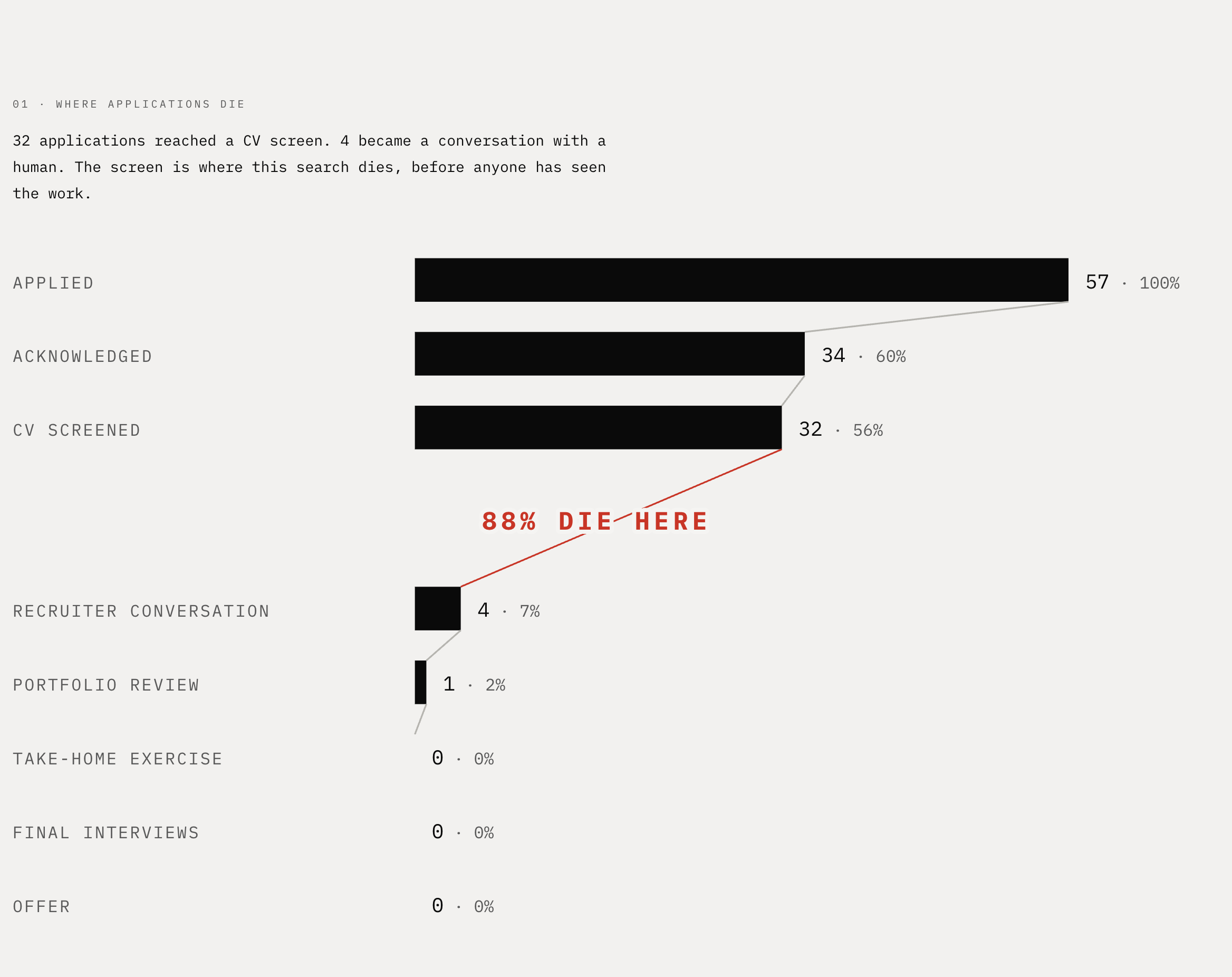
I’m a product designer in Helsinki, currently looking for my next role, a search I now track in public as a live dataset. The case studies, including the decisions log for the AI app I built alone, are on this site. Get in touch.